POCO smartphones have built a reputation for prioritizing gaming performance and competitive hardware. The POCO F9 Pro continues that direction with Qualcomm’s Snapdragon 8 Elite Gen 5 V-series platform, an Adreno 840 GPU, a VisionBoost D8 graphics chipset, 12GB of LPDDR5X 9600Mbps memory, and 512GB of UFS 4.1 storage.
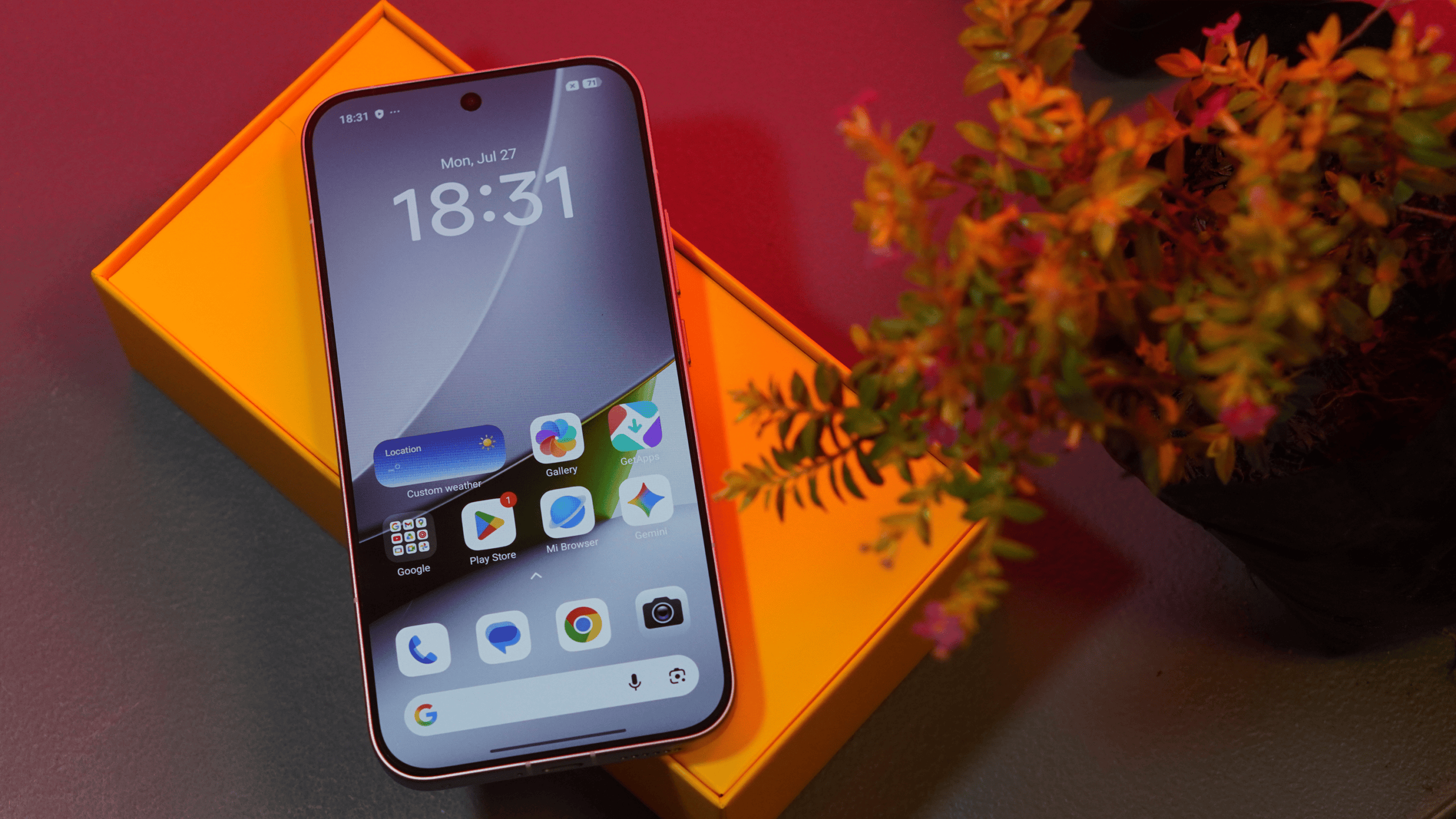
Our review unit runs Android 16 and features a 6.59-inch POCO HyperRGB AMOLED display with a resolution of 2510 × 1156 and a maximum refresh rate of 185Hz. The high-refresh-rate panel complements the phone’s performance-focused hardware, promising smoother motion, responsive controls, and ultra-high-frame-rate gaming in selected compatible titles.
In the Philippines, the POCO F9 Pro is priced at ₱49,999 for the 12GB + 256GB model and ₱54,999 for the 12GB + 512GB model. During the early-bird promotion, these variants will be available for ₱44,999 and ₱49,999, respectively, with a free Redmi Buds 8 Active included with every phone purchase through Shopee and Lazada.

We tested the POCO F9 Pro using AnTuTu Benchmark, Geekbench 7, PCMark, several 3DMark workloads, and eight demanding mobile games. Three 3DMark benchmarks Sling Shot, Sling Shot Extreme, and Wild Life returned “Maxed Out” results, while more intensive stress tests showed some expected performance reduction as temperatures increased. Despite this, the phone remained relatively stable under sustained workloads and delivered smooth real-world gaming, making it one of the most powerful and responsive smartphones we have tested.
Packaging and Contents
The POCO F9 Pro arrives in the brand’s familiar black-and-yellow packaging. The front follows a minimalist presentation, featuring the full POCO F9 Pro name in large yellow lettering against a matte-black background. A small POCO logo appears near the bottom, while the “Sound by Bose” branding is positioned near the upper corner to highlight the phone’s audio quality.
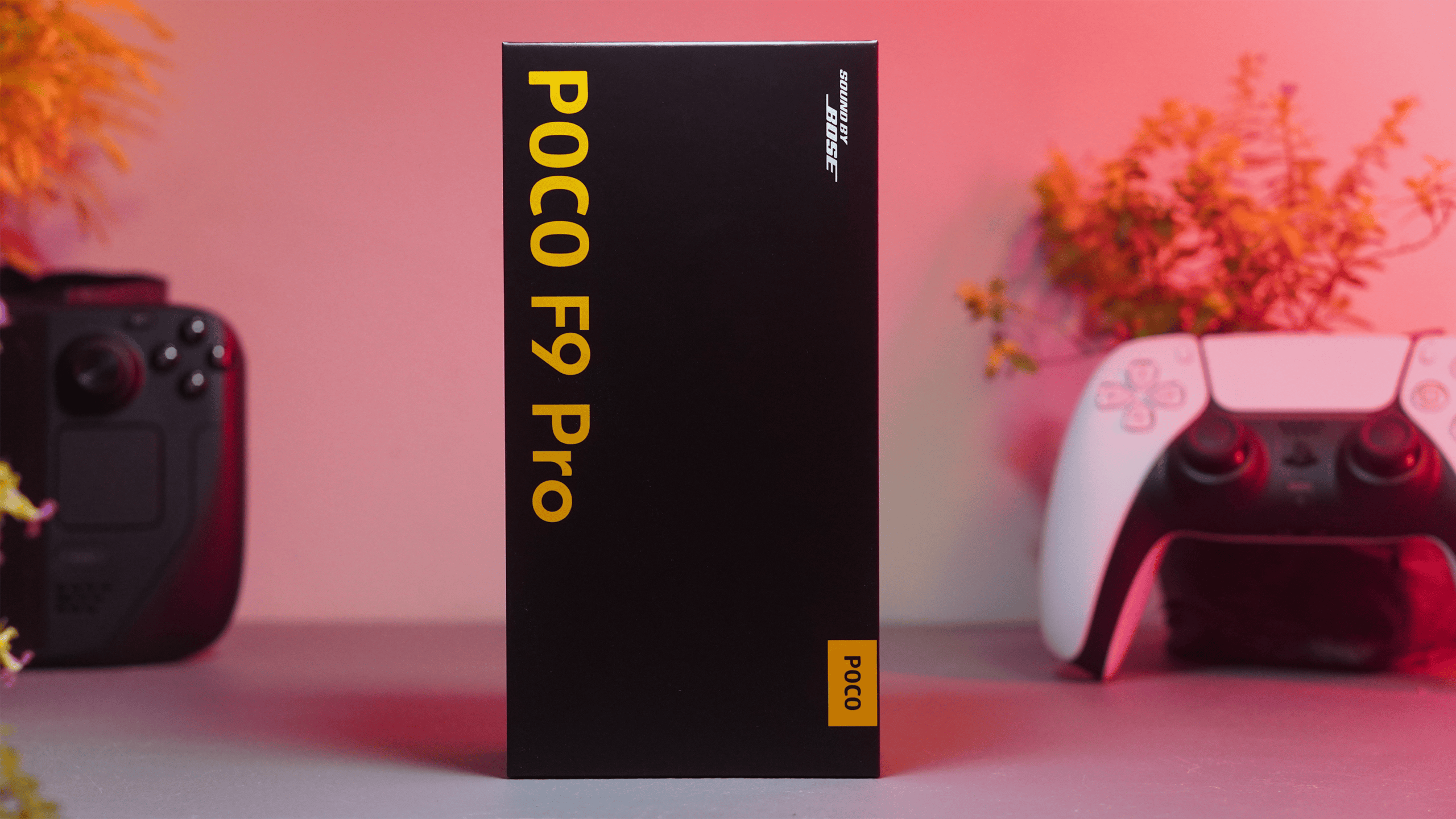
The back retains the mostly black appearance but introduces a large solid yellow that matches POCO’s signature color. The lower section contains the product label, regulatory markings, certification symbols, barcodes, and other manufacturing information. Branding along the side keeps the exterior recognizable without making the box look overly busy.
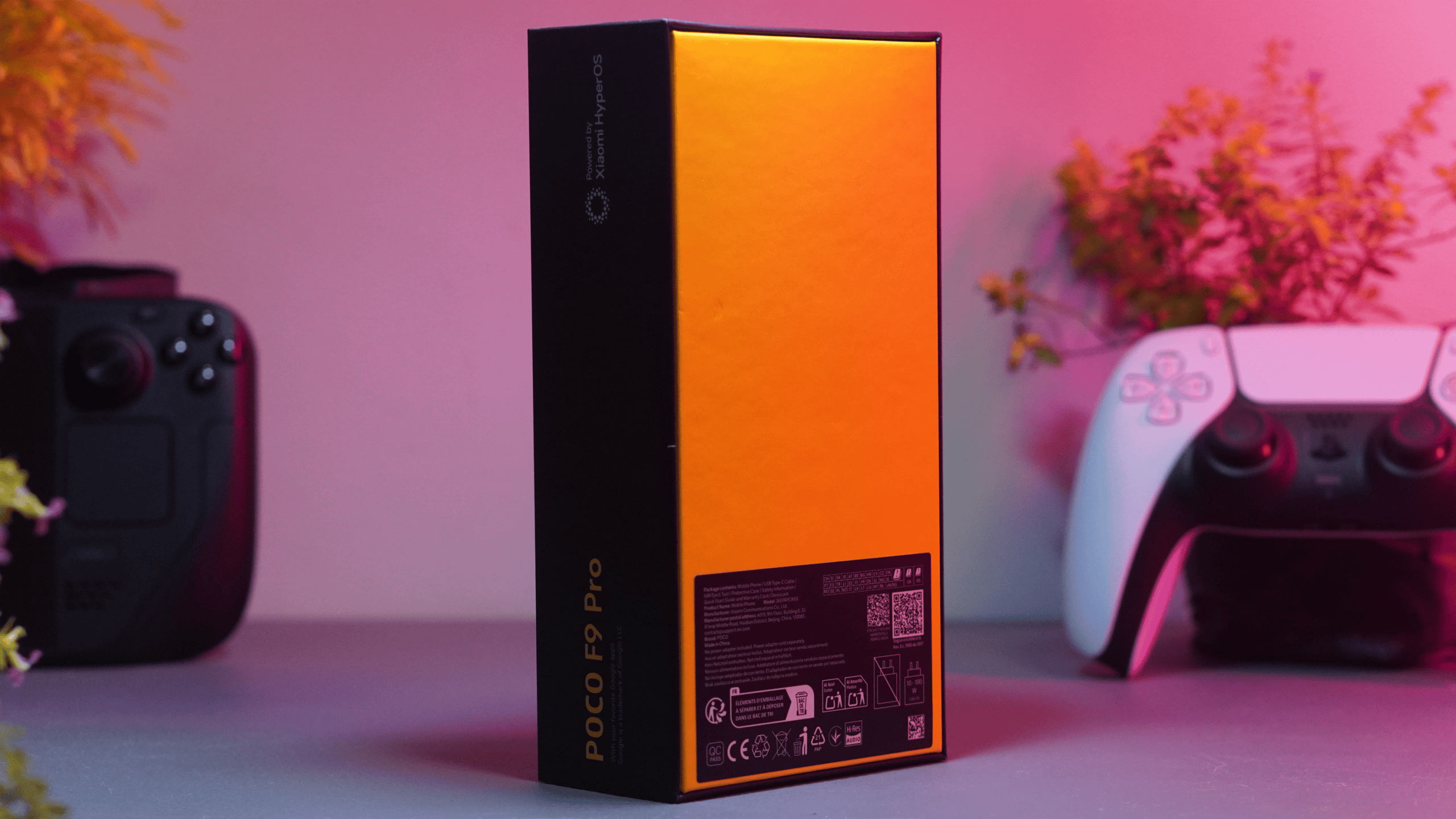
Lifting the cover reveals a bright-yellow interior that contrasts sharply with the black exterior. The first compartment carries the POCO branding and houses the included accessories and documentation.
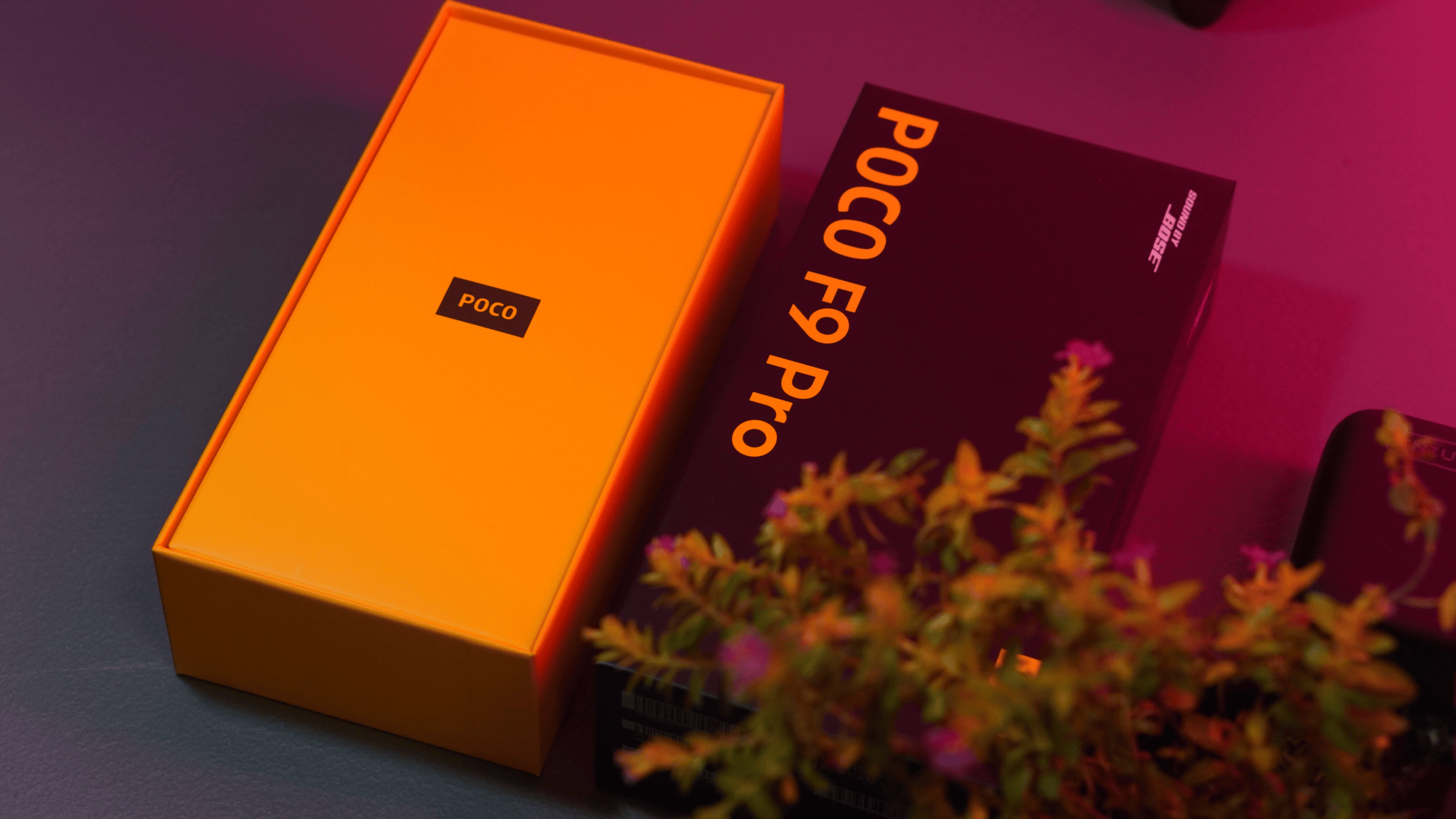
Beneath it, the phone rests securely inside the main tray and comes wrapped in a protective sleeve. Its front film highlights several of its major features.
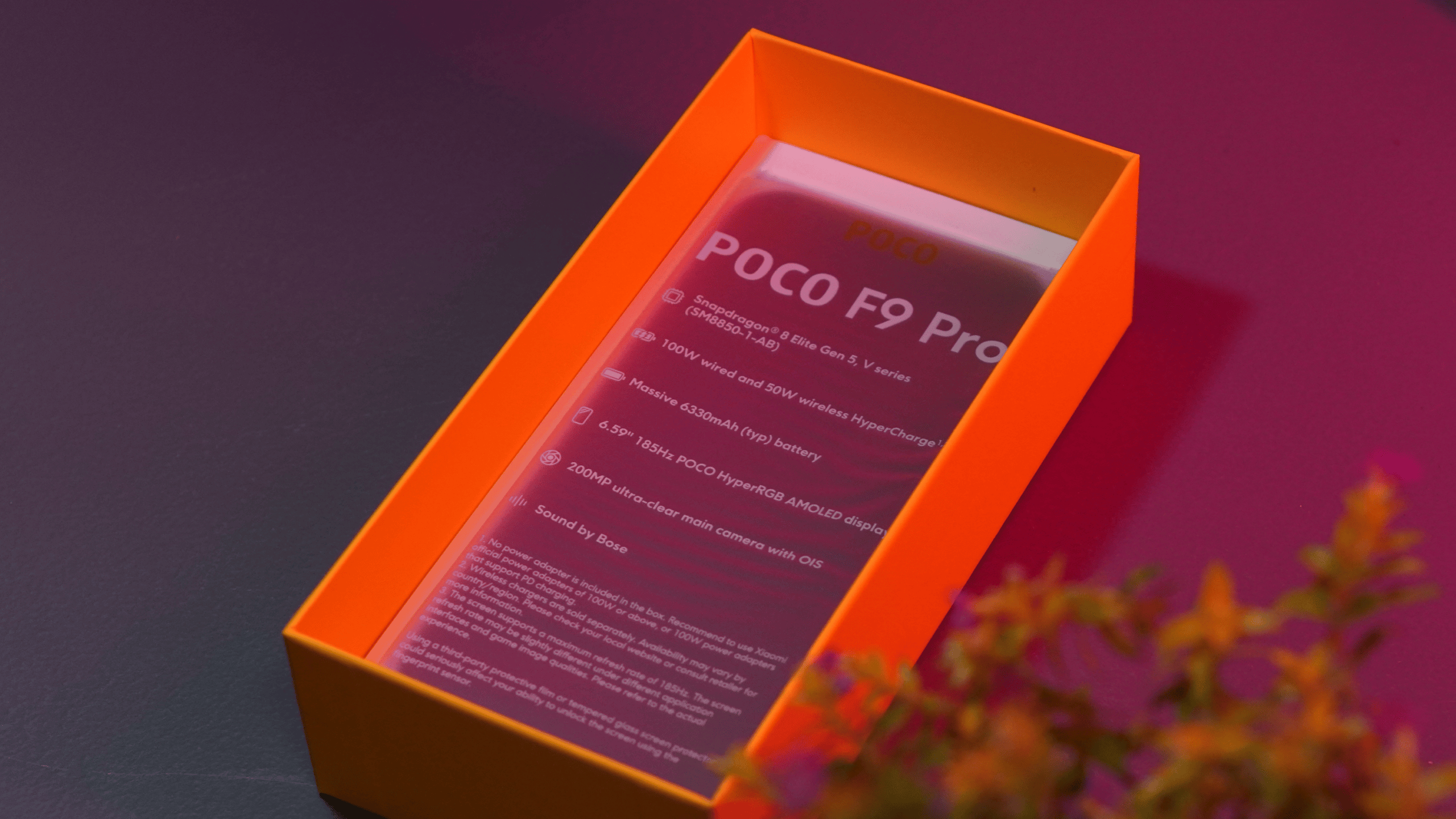
Inside the box, POCO includes the following:
- POCO F9 Pro
- USB Type-C charging cable
- Transparent protective case
- SIM ejector tool
- Quick-start guide and warranty documentation
- Energy-efficiency information
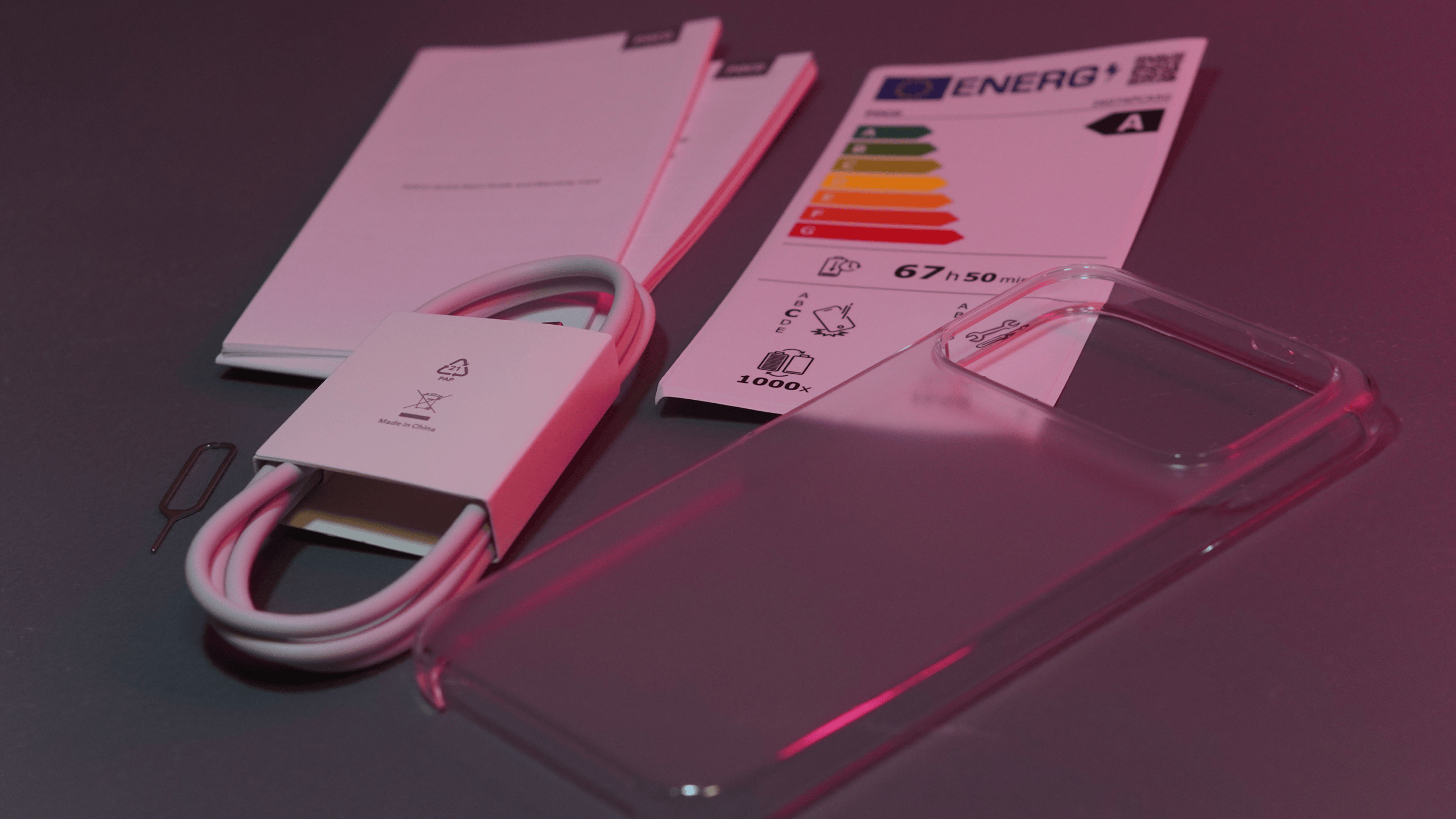
POCO also includes a transparent protective case, allowing you to protect the phone immediately without hiding its original color and design.
Design and Build Quality
The POCO F9 Pro adopts a cleaner and more refined appearance than the aggressive designs commonly associated with gaming-focused smartphones.
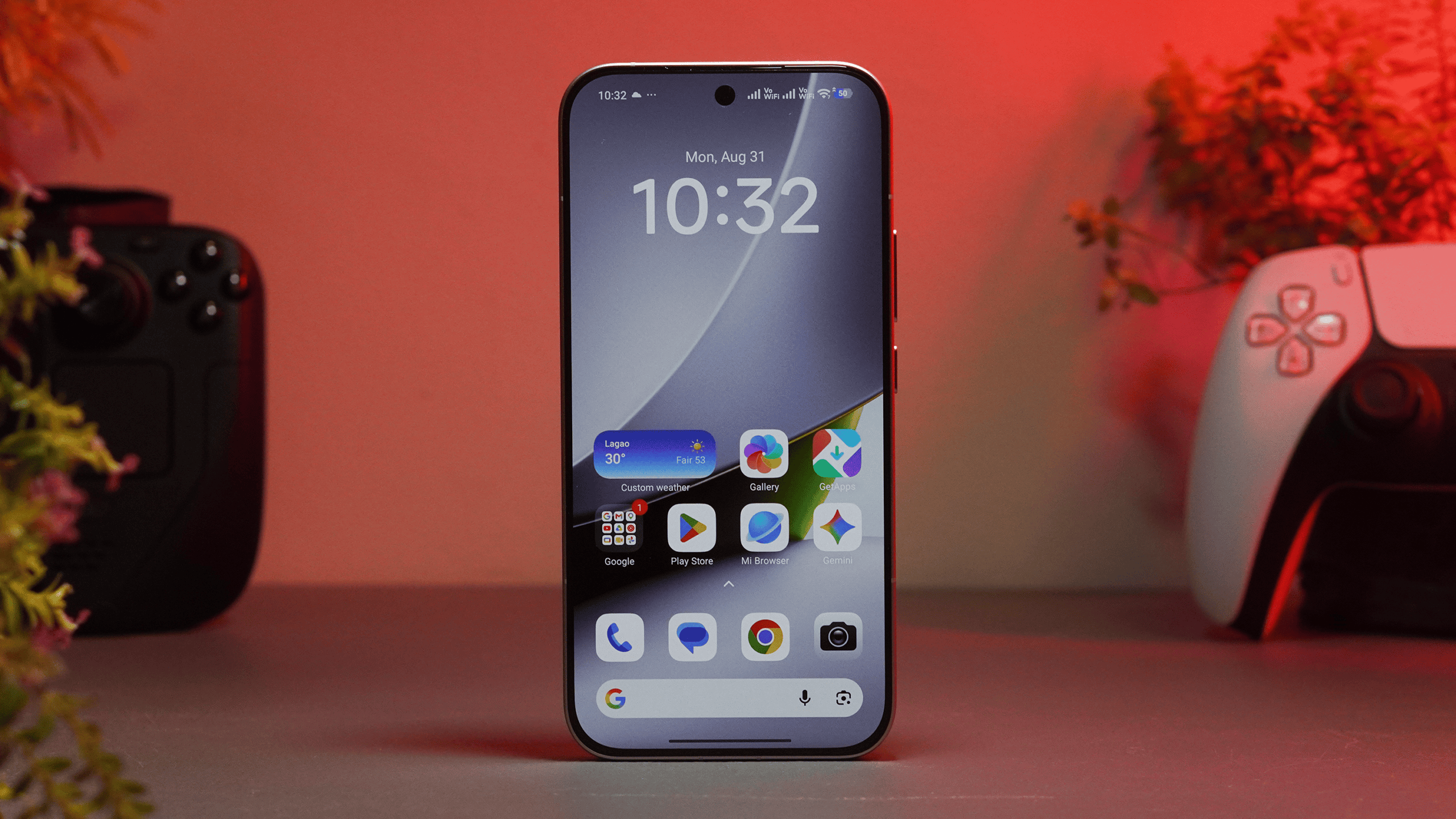
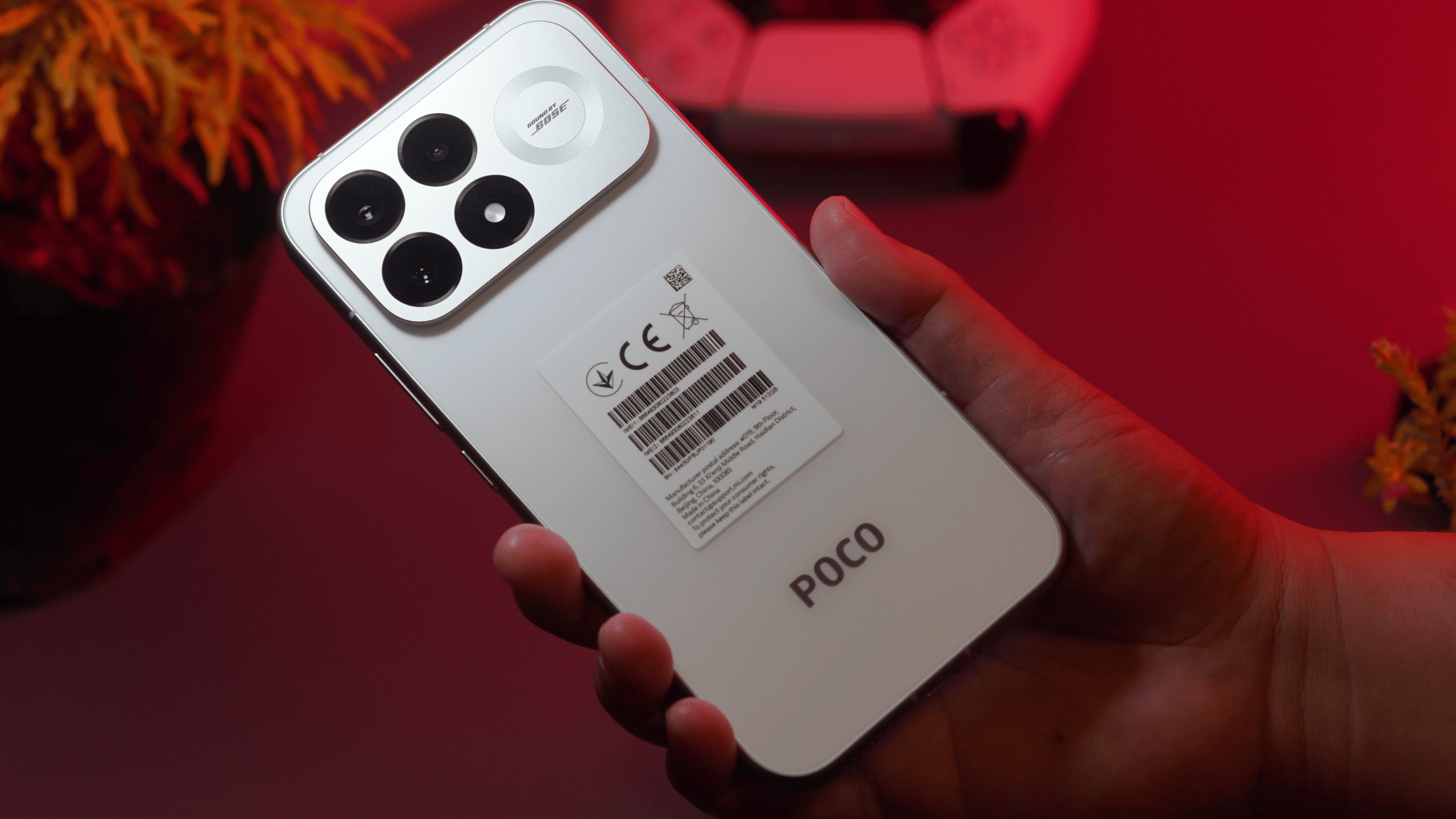
Our review unit comes in a white finish paired with a silver-colored flat frame, giving it a simple and understated look. The POCO logo is positioned near the bottom of the rear panel. The most noticeable design element is the large rectangular camera island occupying the upper portion of the back.
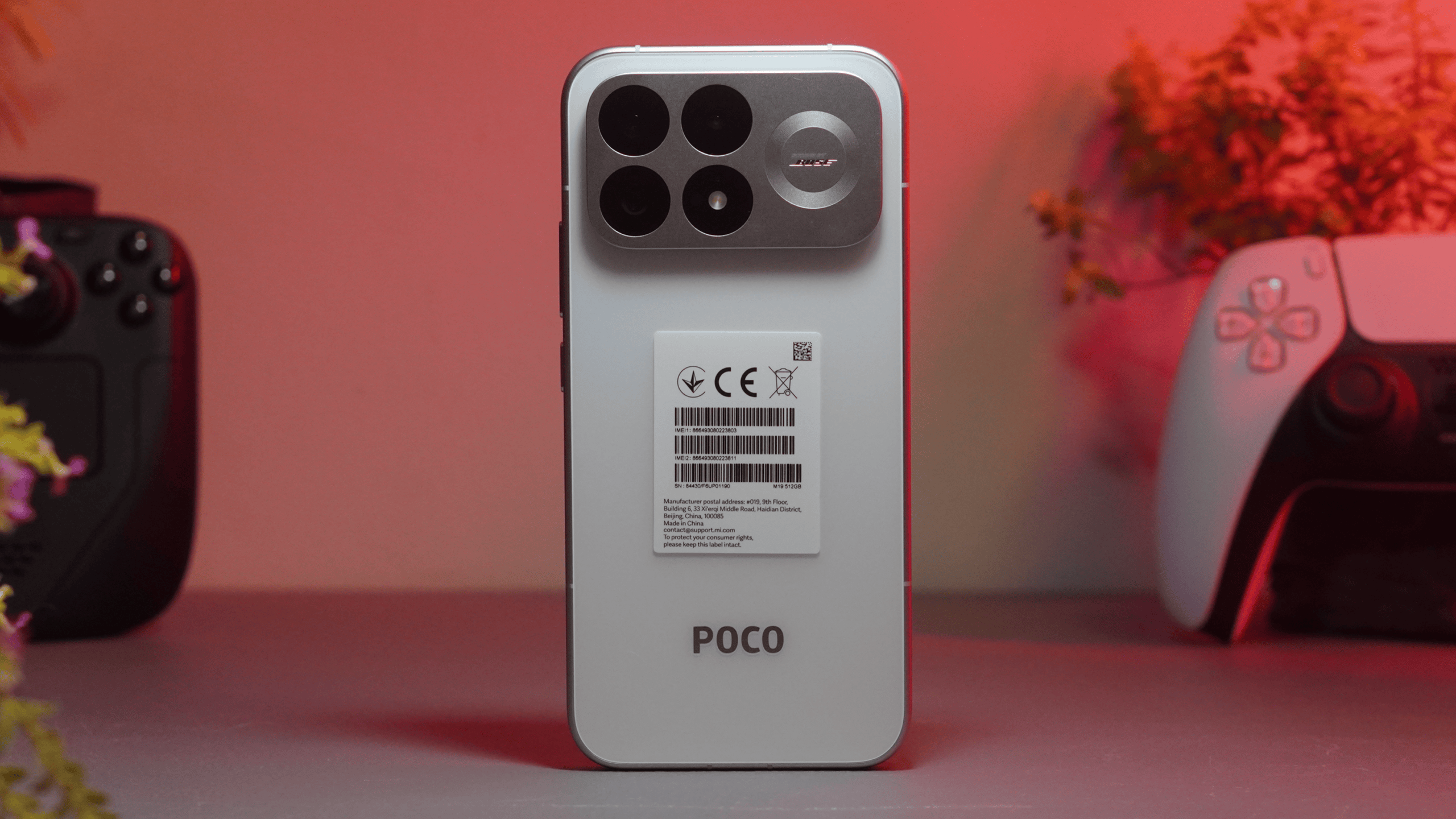
It contains five circular cutouts for the rear cameras and LED flash, while a separate circular accent carries the Bose branding. The camera housing uses a metallic finish that contrasts with the white rear panel, making it the phone’s visual centerpiece.
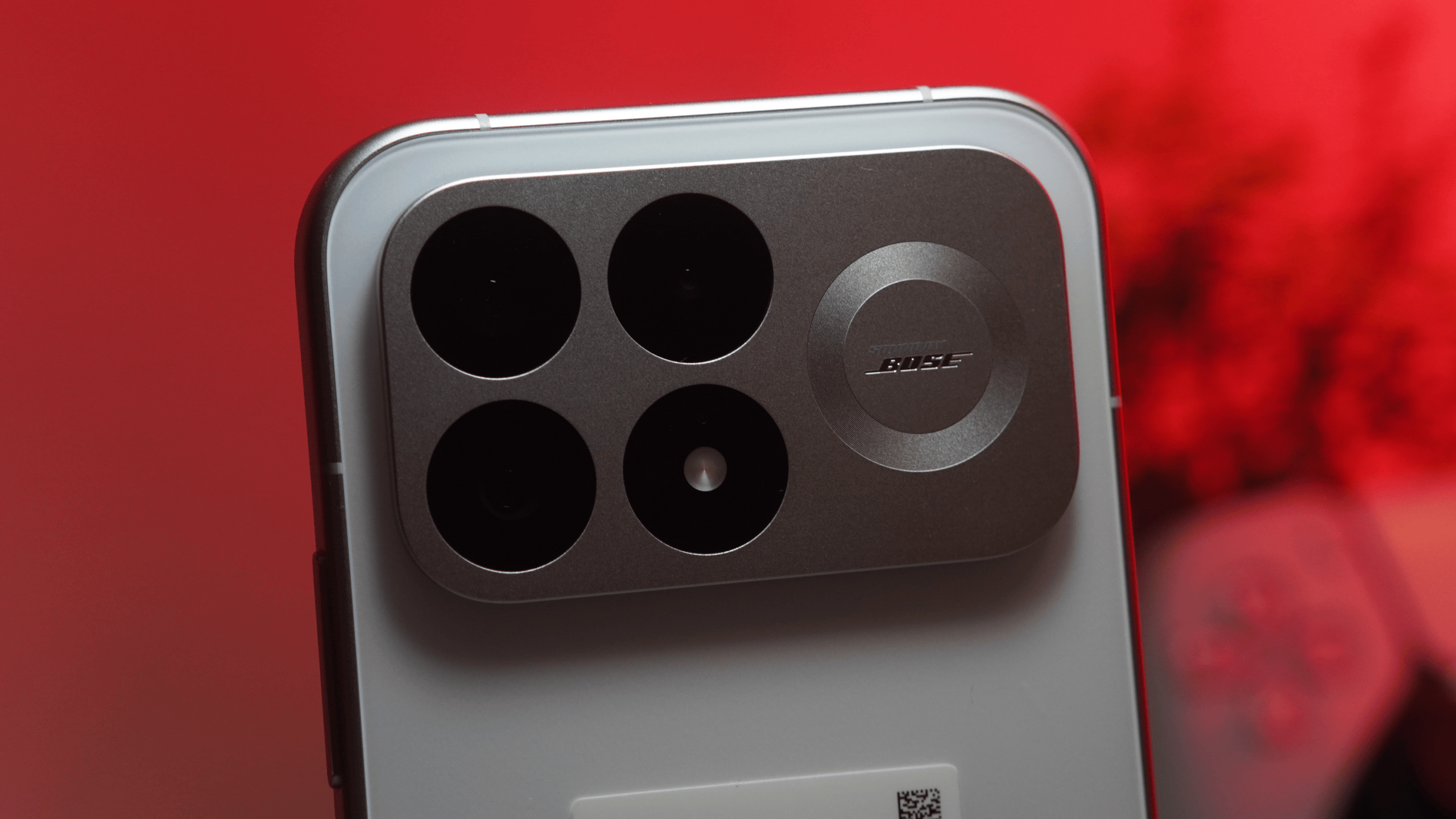
The camera island protrudes considerably from the rear panel, but its wide and even design keeps the phone stable when placed flat on a table without noticeable rocking. The included transparent case adds protection around the camera housing and reduces direct contact with surfaces while still preserving the phone’s original appearance.
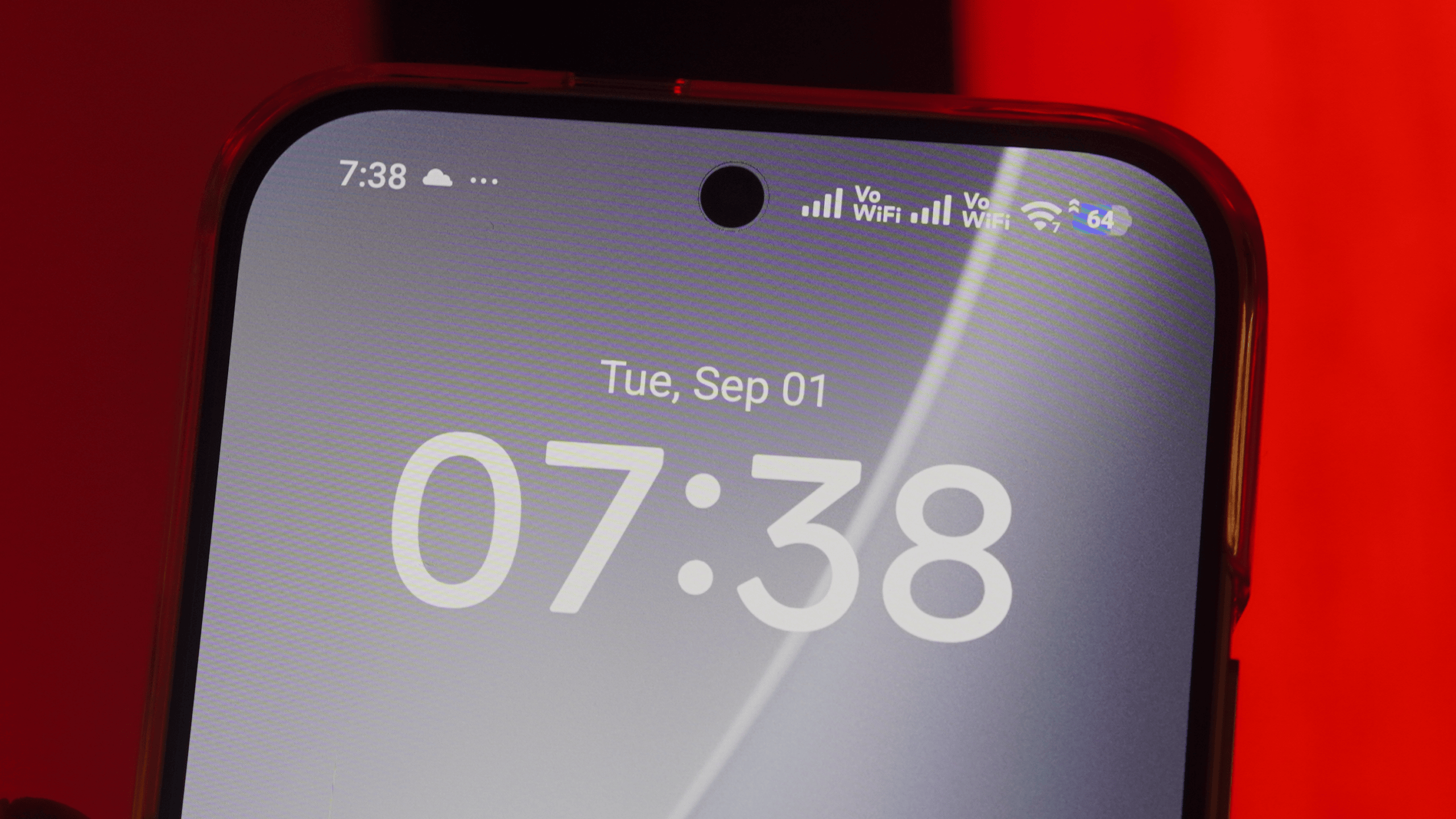
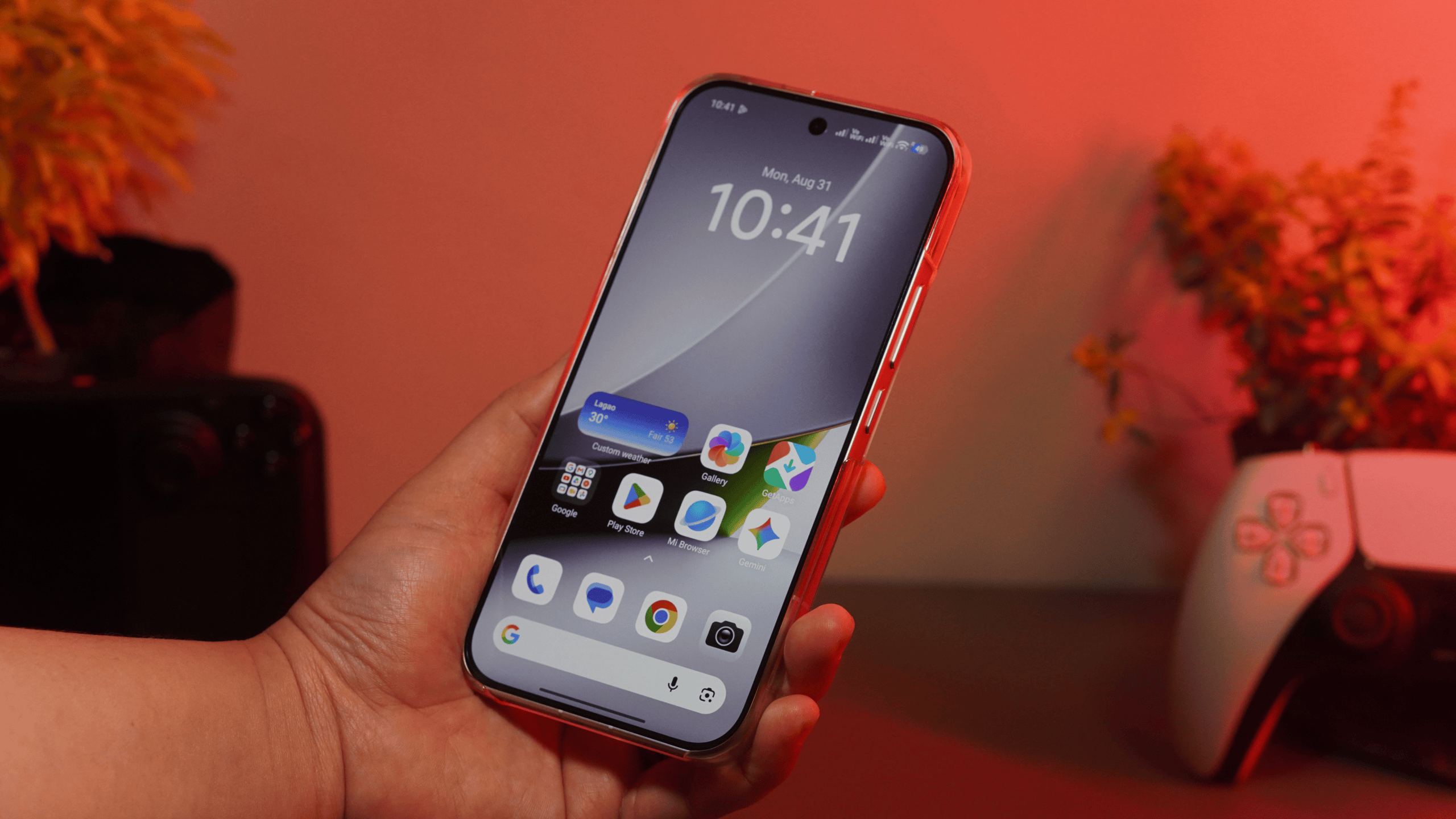
At the front, the POCO F9 Pro features a flat display with slim bezels and rounded corners. The bezels appear relatively uniform around the panel, while the front-facing camera is placed inside a small centered punch-hole. This gives the phone a modern, screen-focused appearance without relying on curved display edges.
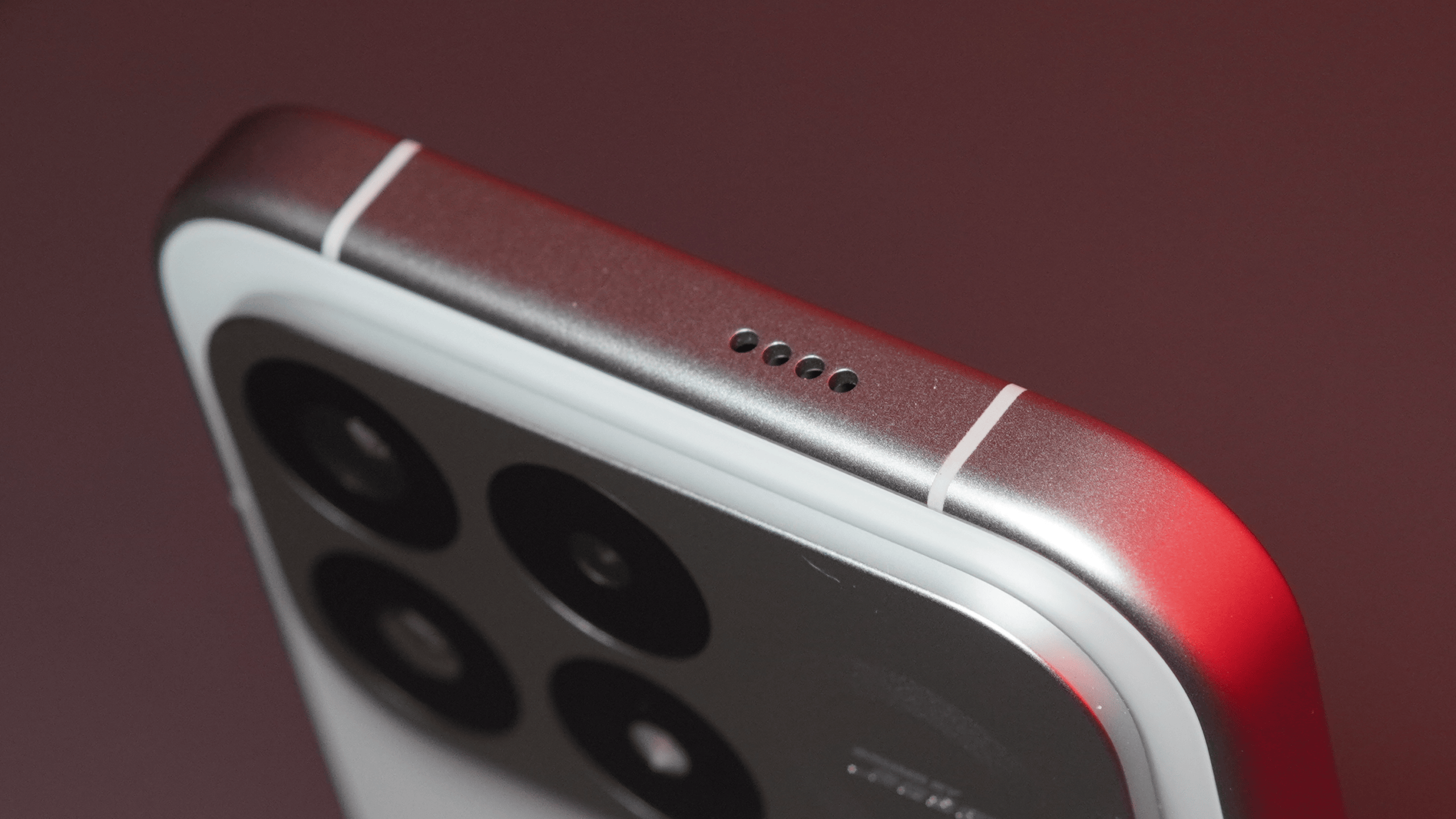
The flat frame provides defined edges that make the POCO F9 Pro easier to grip. Its rounded corners also prevent the phone from feeling excessively sharp in the hand, while the clean frame complements its understated flagship-inspired appearance. The top edge features an opening for the secondary speaker, which works with the bottom speaker to produce stereo audio. Its discreet placement keeps the upper portion of the frame clean without affecting the phone’s symmetrical appearance.
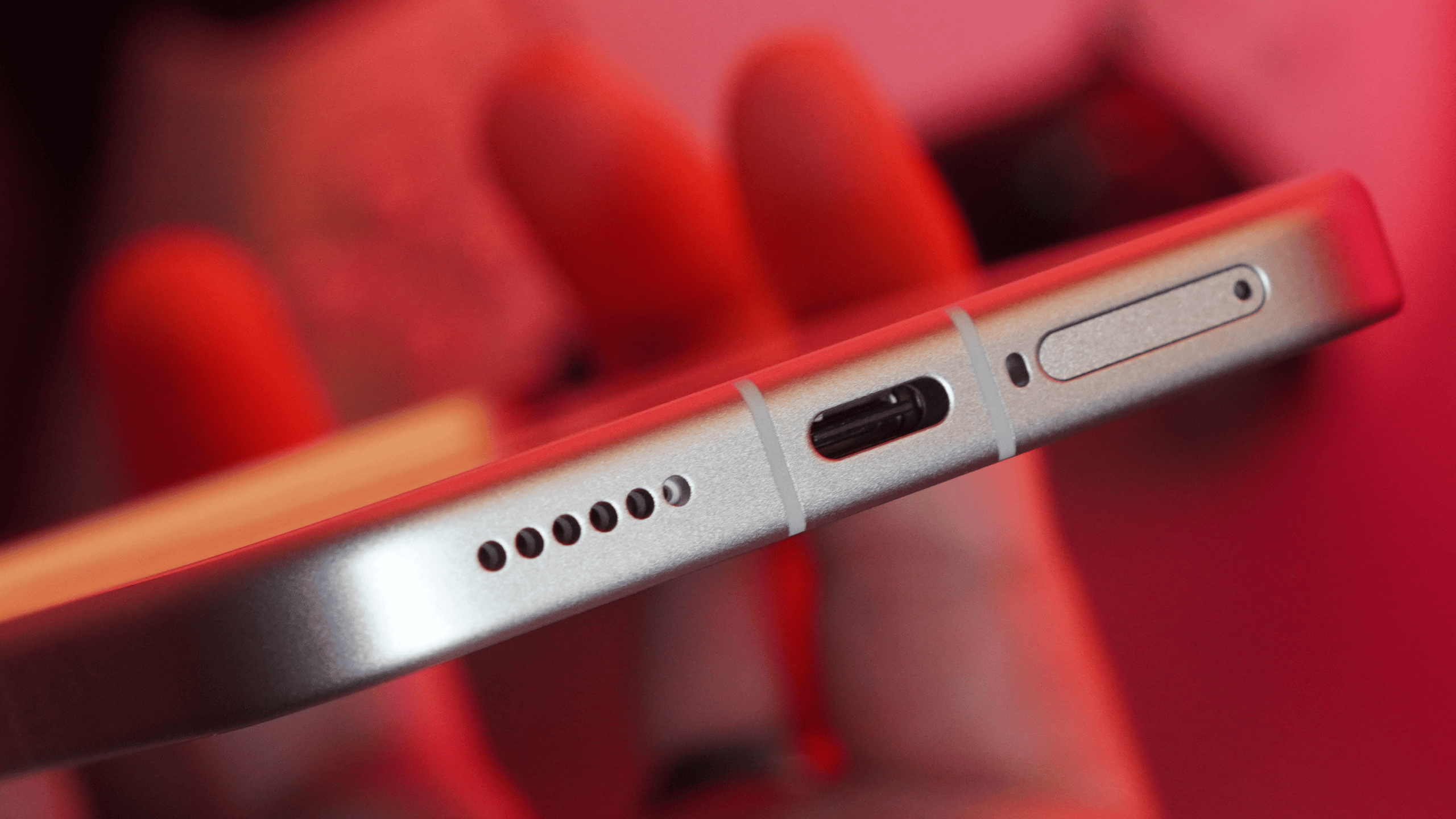
At the bottom, users will find the main speaker grille, USB Type-C charging and data port, SIM-card tray, and primary microphone opening. The components are arranged neatly across the flat edge.
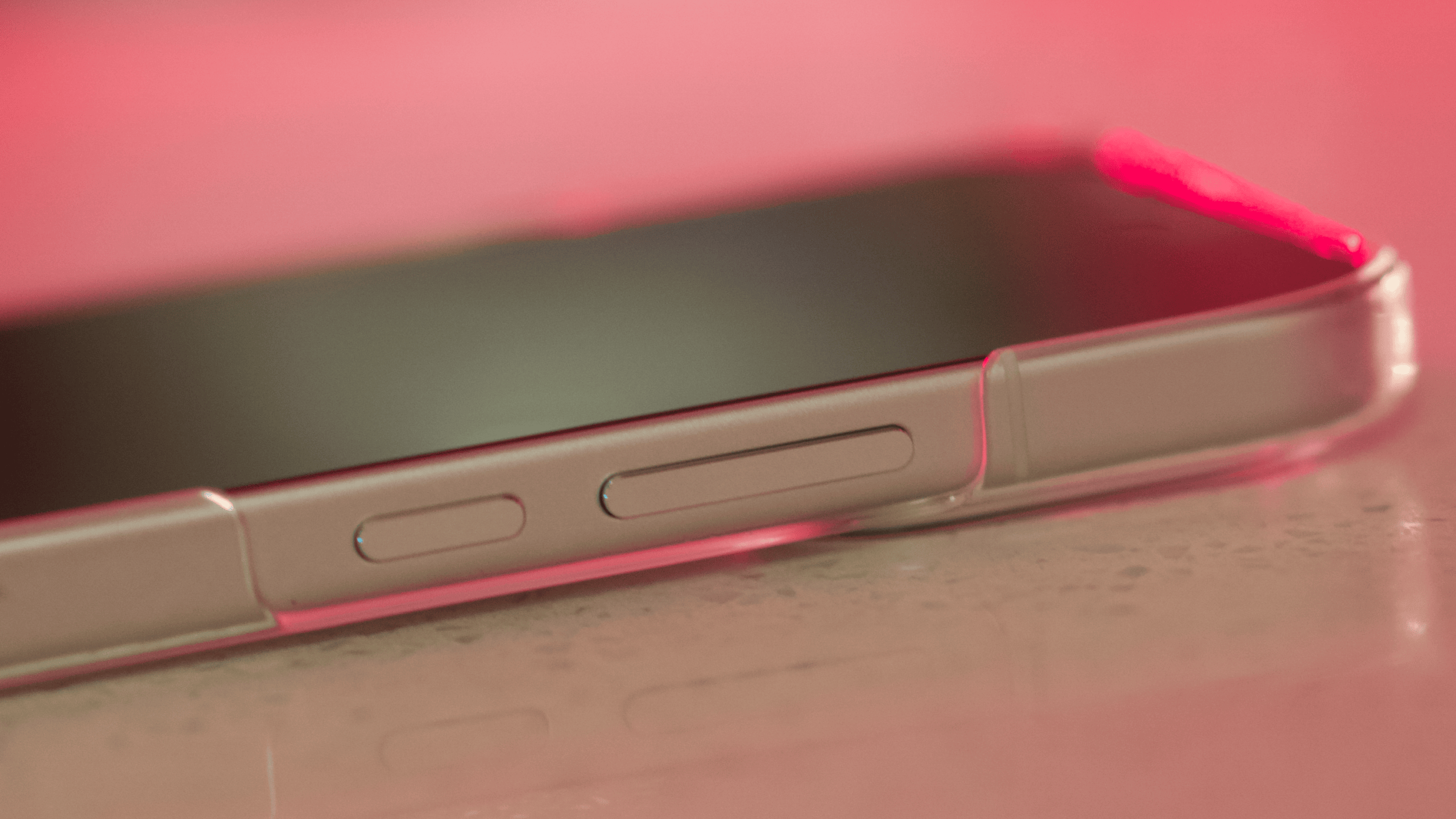
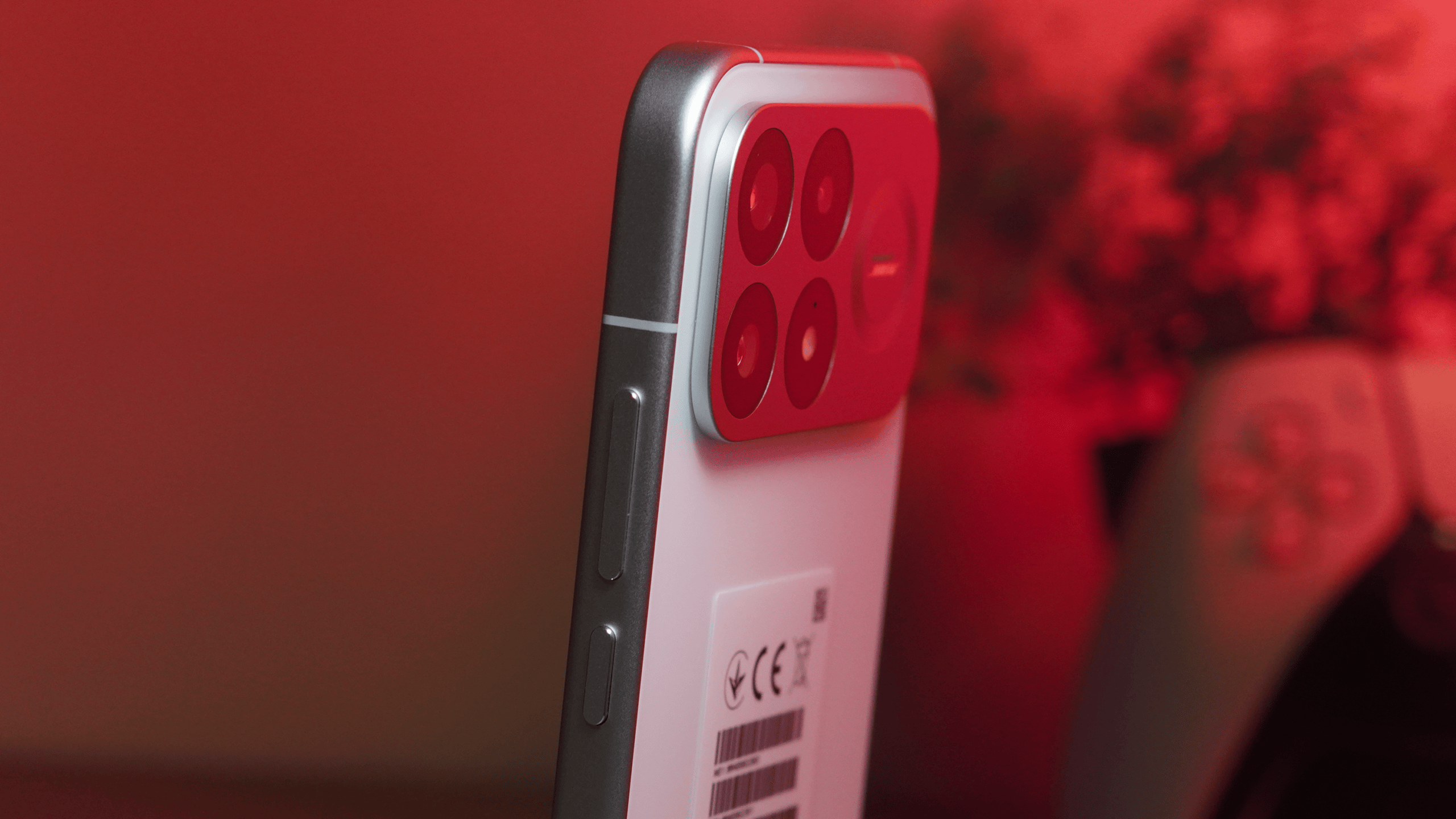
Along the right edge, the elongated volume rocker sits above the power button. Both controls are positioned within easy reach and are separated enough to identify by touch, which is particularly useful when adjusting the volume or locking the screen during gaming.
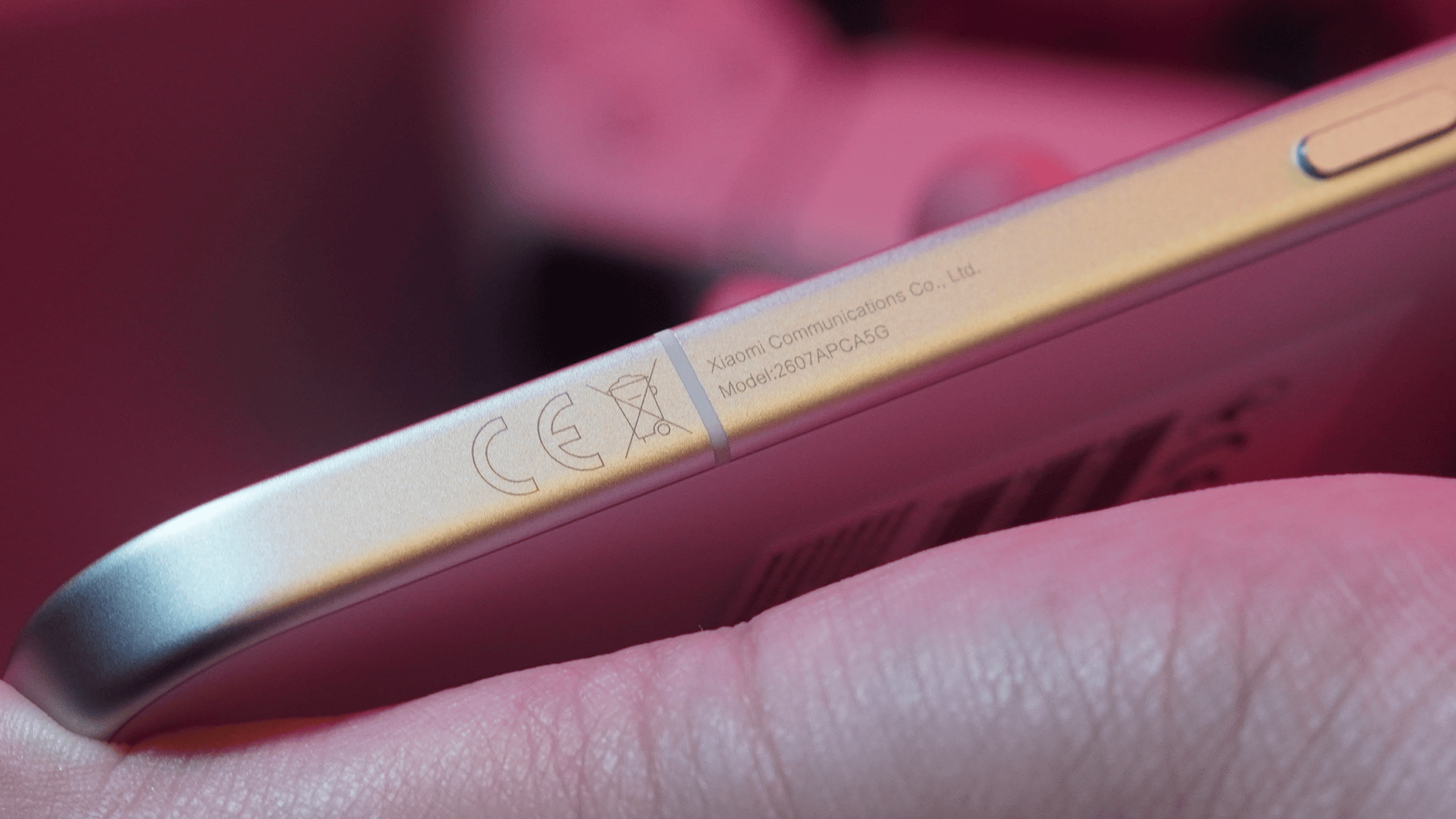
The lower portion of the same edge carries subtly engraved regulatory and identification markings. The markings are small and lightly printed, so they do not significantly disrupt the frame’s clean appearance.
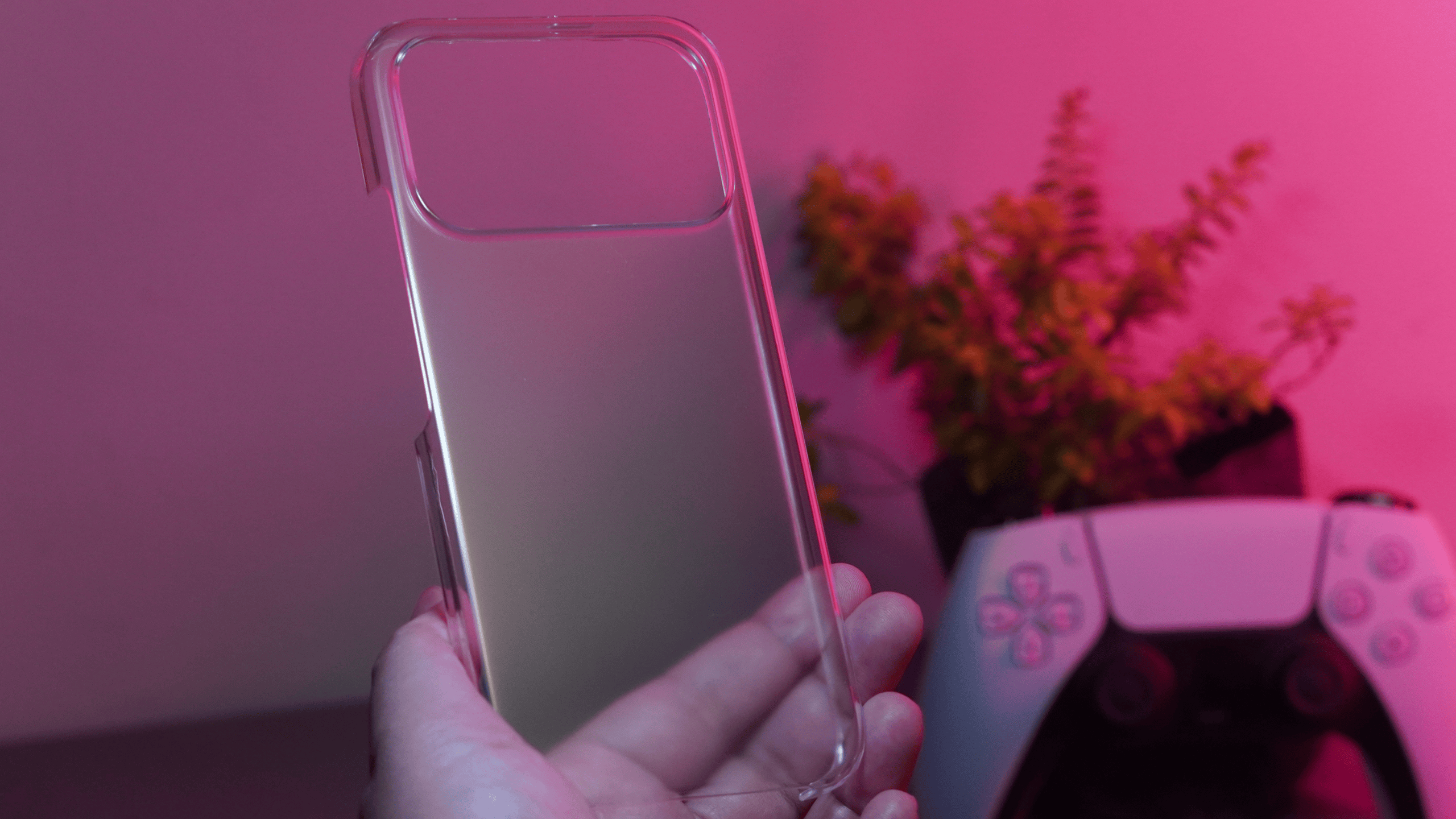
Once the transparent protective case is installed, the clear material preserves the white rear panel, silver-colored frame, POCO branding, and distinctive camera layout instead of changing the phone’s overall appearance.
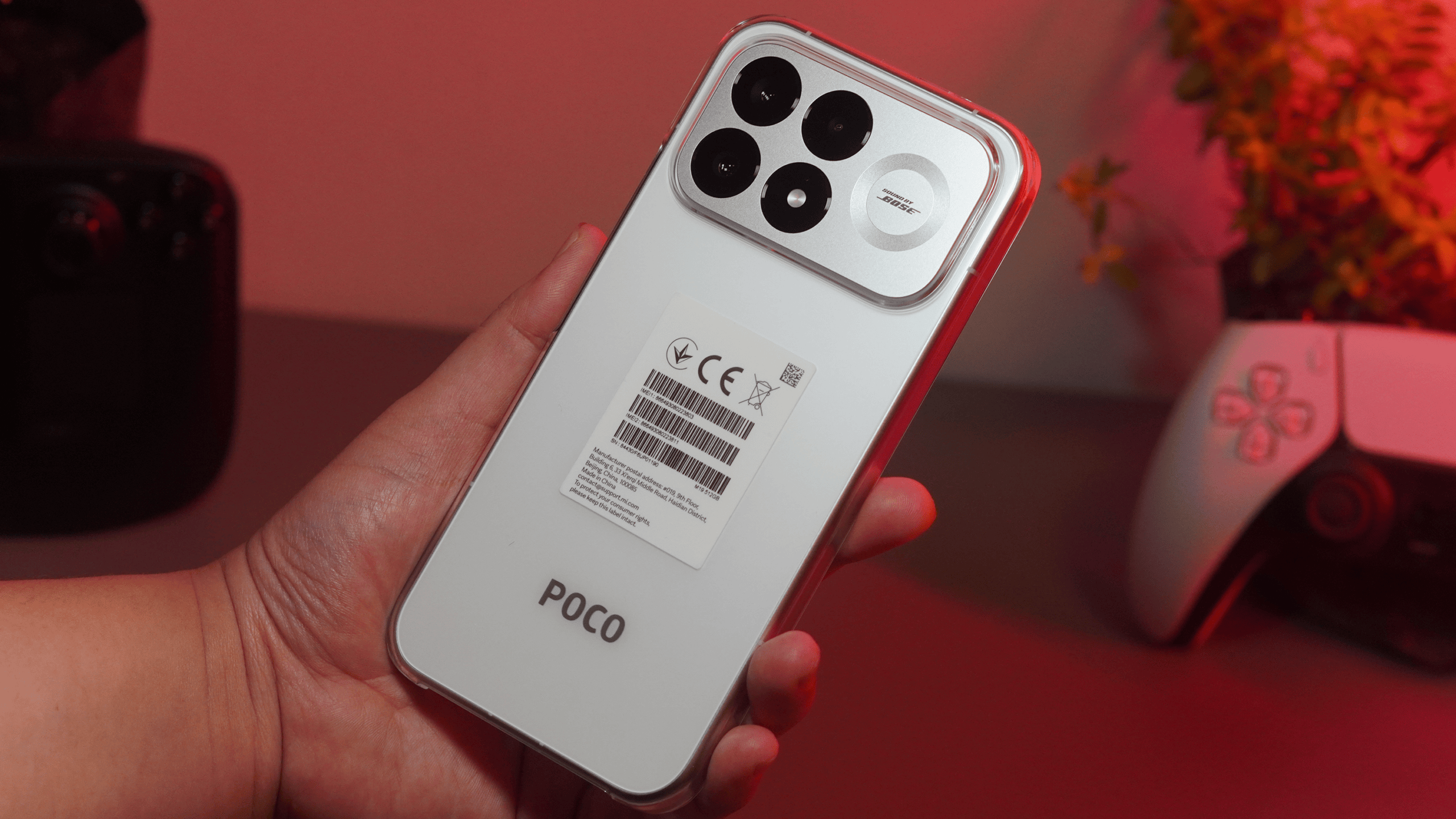
The case fits closely around the phone and adds only a small amount of visible bulk. Its raised border provides additional coverage around the large camera housing, while reinforced corners help protect against minor bumps.

Precisely positioned openings keep the USB Type-C port, speakers, microphone, and SIM-card tray accessible, while the side controls remain easy to press.
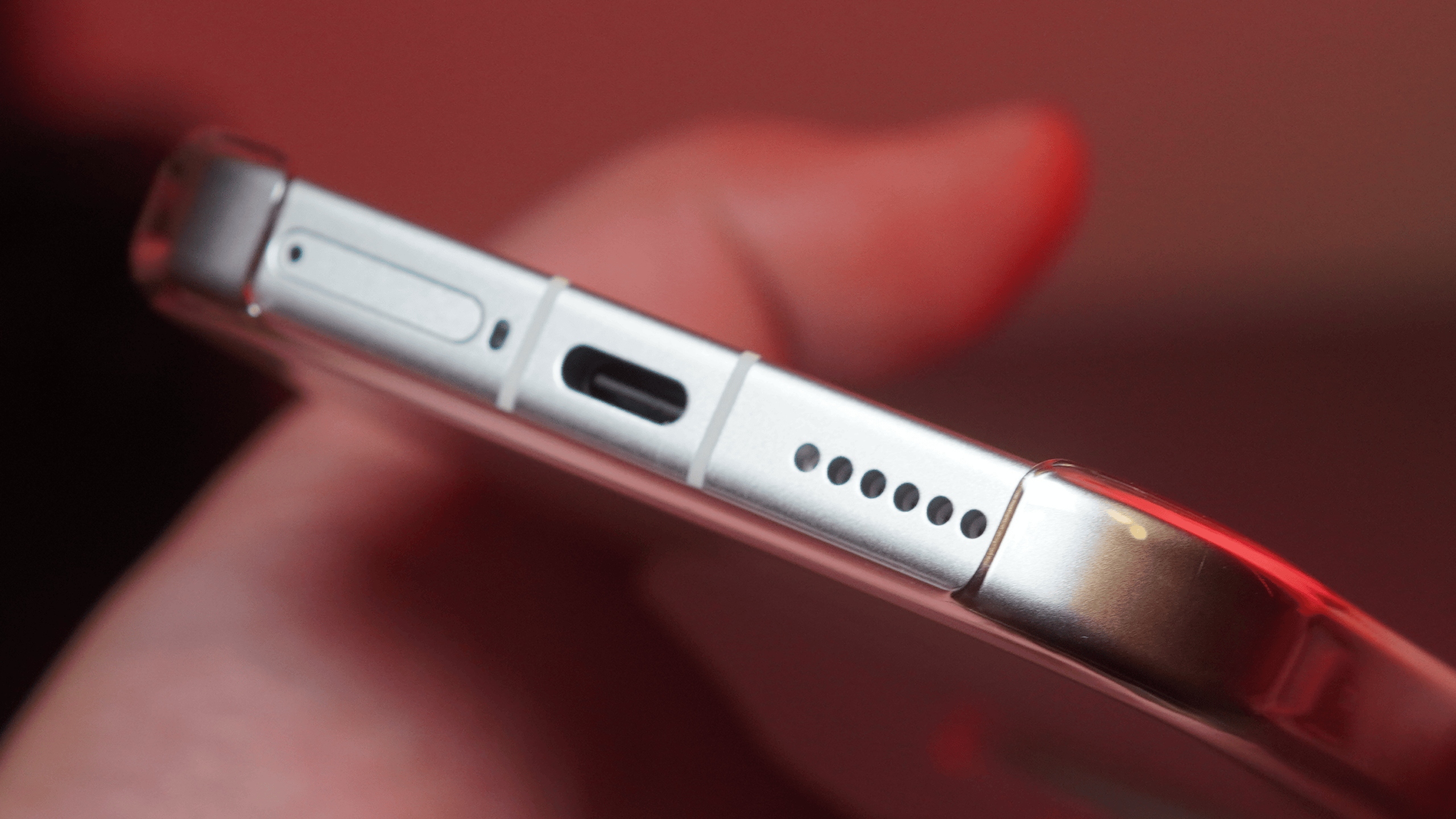
Although users may eventually prefer a thicker third-party case for stronger drop protection, the included case looks clean and is practical for everyday use.
Performance
The POCO F9 Pro is powered by Qualcomm’s Snapdragon 8 Elite Gen 5 V series processor and Adreno 840 GPU, supported by 12GB of LPDDR5X memory and 512GB of internal storage. We tested the phone using AnTuTu Benchmark, Geekbench 7, PCMark, and 3DMark to measure its processing, graphics, storage, thermal, and sustained performance.
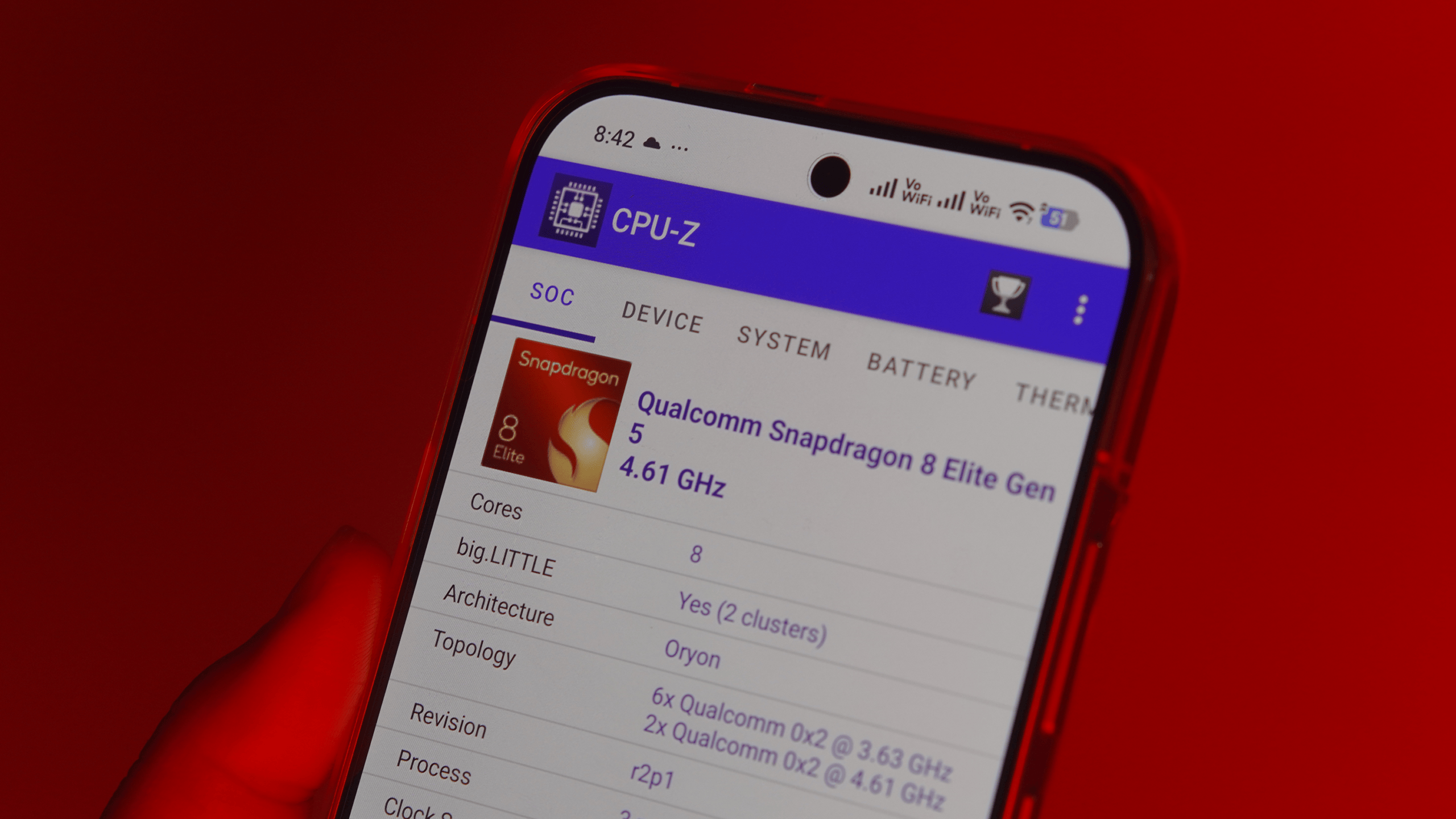
Before that, here are the full specification of the phone:
| Category | Specification |
| Processor | Qualcomm Snapdragon 8 Elite Gen 5, V series (SM8850-1-AB)All-Big-Core architecture3nm manufacturing processOcta-core CPU2 x Prime Core, up to 4.6GHz6 x Performance Core, up to 3.62 GHz |
| GPU | Adreno 840 |
| Dedicated Secondary Graphics and Visual Processing | VisionBoost D8 Chipset12nm manufacturing processSuper resolutionSmart frame rateGame HDRDual-core Visuals |
| Gaming optimization | WildBoost Engine |
| Memory | 12GB LPDDR5X 9600Mbps |
| Storage | 256GB or 512GB UFS 4.1 |
| Operating system | Android 16 |
| Display | 6.59-inch AMOLED, M11 panel |
| Resolution | 2510 × 1156, 1.5K POCO HyperRGB |
| Maximum refresh rate | Up to 185Hz |
| Multi-finger touch sampling | Up to 480Hz across ten touch points |
| Instant touch sampling | Up to 4,800Hz through Game Turbo Mode |
| Gyroscope sampling | Up to 200Hz in selected supported games |
| Peak brightness | 4,500 nits at 25% APL |
| Local peak brightness | Up to 10,000 nits at 1% APL |
| Eye-care features | Xiaomi Vision Care and 1-nit low-light viewing |
| Main camera | 200MP with OISf/1.68 |
| Telephoto camera | 50MP floating telephoto with 2.5x optical zoom and OIS |
| Ultra-wide camera | 8MP |
| Front camera | 32MP |
| Video features | 4K Live Cinematography |
| Battery | 6,330mAh typical capacity |
| Wired charging | up to 100W HyperCharge |
| Wireless charging | 50W HyperCharge |
| Wired reverse charging | Up to 27W |
| Wireless reverse charging | Up to 22.5W |
| Speakers | Dual 1115F symmetrical stereo speakers |
| Audio tuning | Sound by Bose |
| USB port | USB Type-C |
| Dual SIM | Bottom-mounted SIM-card tray Configuration:Nano SIM + Nano SIMor Nano SIM + eSIM or eSIM + eSIM |
| Weight | 206g |
| Dimension | 157.49 x 75.25 x 8.79mm |
| Colors | Aurora Green, Black, and White |
| Variants | 12GB + 256GB and 12GB + 512GB |
AnTuTu Benchmark v11.1.5
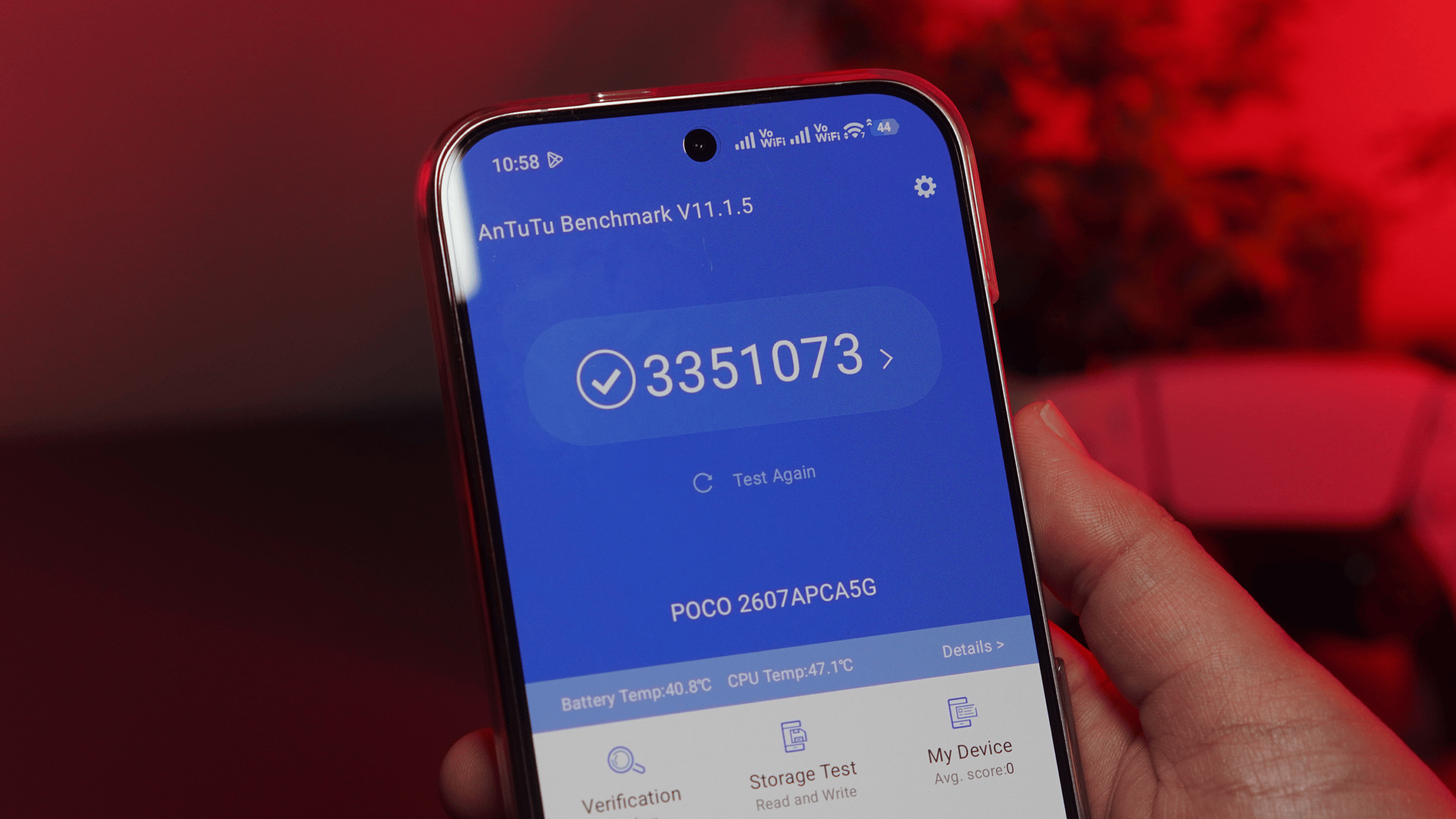
| Category | Score | Comparative result |
|---|---|---|
| Overall | 3,351,073 | Defeated 82% of users |
| CPU | 1,041,911 | Defeated 86% of users |
| GPU | 1,083,375 | Defeated 64% of users |
| Memory | 515,966 | Defeated 92% of users |
| UX | 709,821 | Defeated 81% of users |
The POCO F9 Pro achieved an overall score of 3,351,073 in AnTuTu Benchmark v11.1.5, placing it eighth among Android smartphones in the benchmark rankings. Its memory performance delivered the strongest comparative result, surpassing 92% of tested devices, followed by the CPU at 86%, UX at 81%, and GPU at 64%.
| AnTuTu Monitoring | Result |
|---|---|
| Starting temperature | 33.1°C |
| Ending temperature | 37.9°C |
| Temperature increase | 4.8°C |
| Battery consumed | 7% |
During the complete AnTuTu run, the recorded temperature increased by 4.8°C while the battery level dropped by 7%. This is a relatively controlled thermal result for a demanding benchmark and suggests that the cooling system can initially manage the chipset without allowing temperatures to rise too aggressively.
Geekbench 7 CPU Benchmark
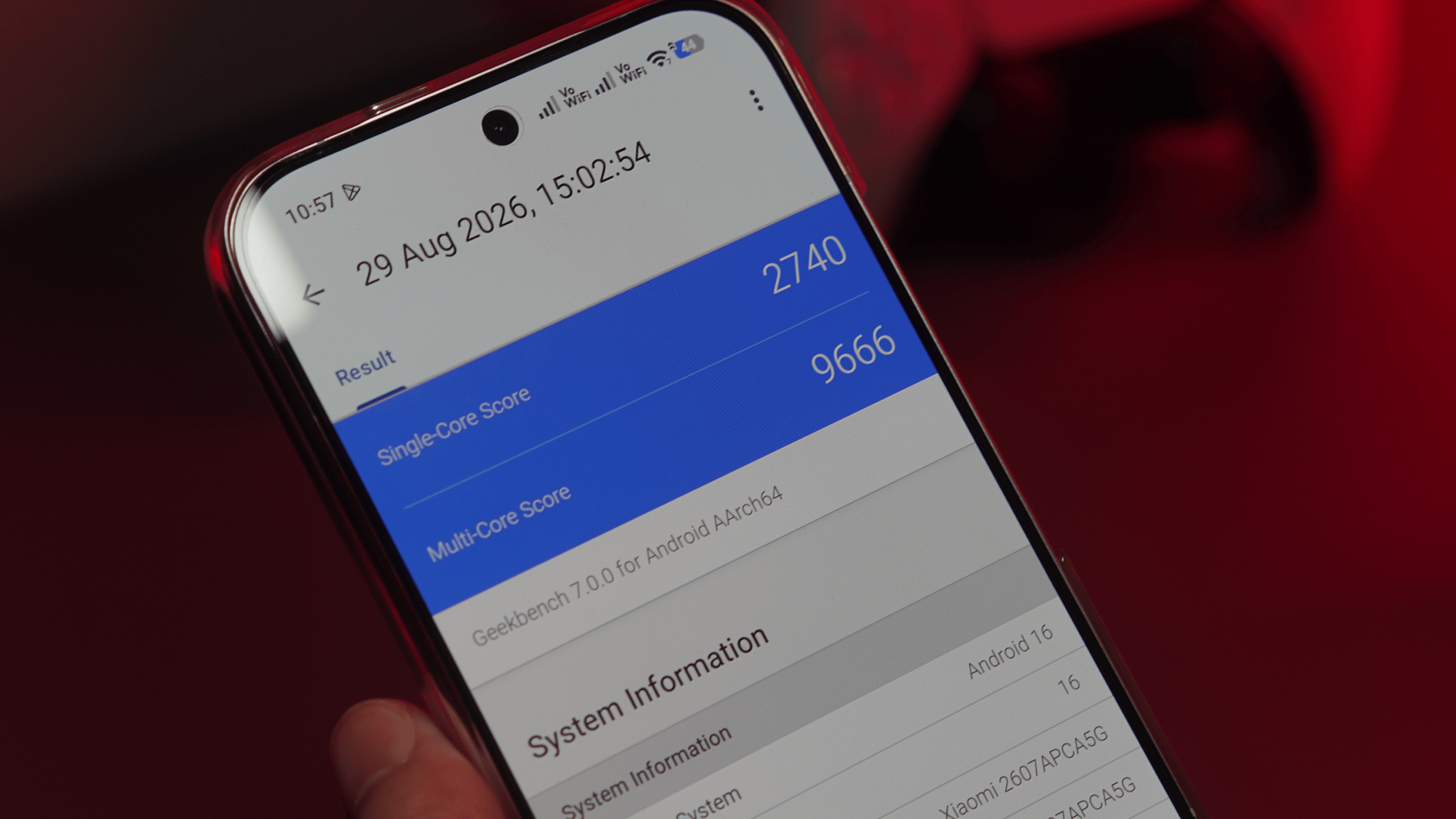
| Test | Score |
|---|---|
| Single-core | 2,740 |
| Multi-core | 9,666 |
The Geekbench 7 results highlight the phone’s processing capability across both single-threaded and multi-threaded workloads. These scores suggest that the device should comfortably handle demanding applications, multitasking, background processes, and CPU-heavy mobile games.
Geekbench 7 GPU Benchmark
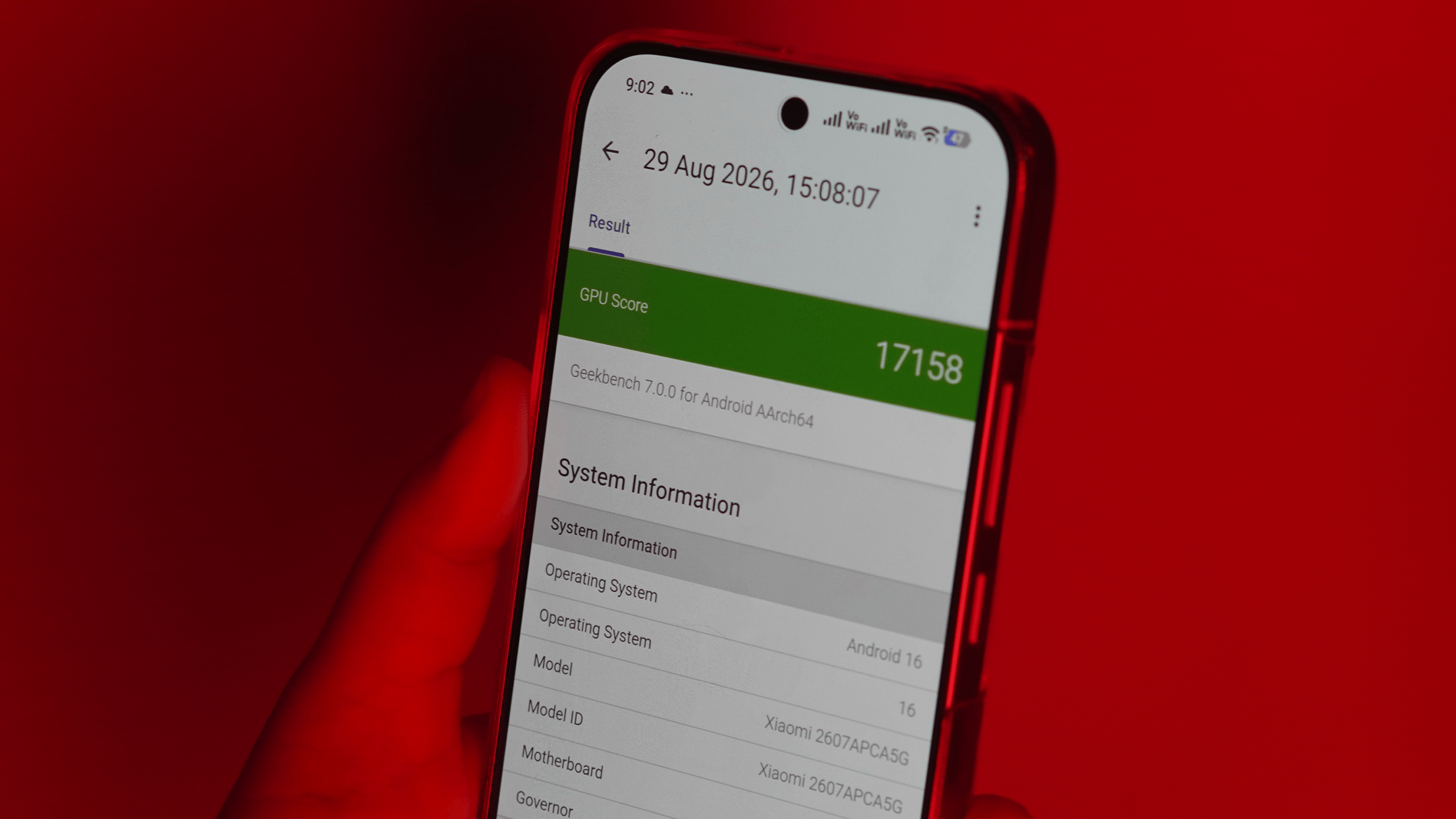
| Test | Score |
|---|---|
| GPU OpenCL | 12,463 |
| GPU Vulcan | 17,724 |
The POCO F9 Pro recorded a score of 12,463 in the Geekbench 7 OpenCL test and a higher score of 17,724 using Vulkan. Powered by the Adreno 840 GPU, these results demonstrate strong graphics and compute performance for gaming, image processing, video applications, and other GPU-accelerated workloads.
PCMark Benchmark

| PCMark test | Score |
|---|---|
| Work 3.1 Performance | 20,677 |
| Storage 2.1 | 60,108 |
PCMark Work 3.1 evaluates common productivity workloads such as web browsing, document editing, data processing, and photo or video-related tasks, while Storage 2.1 measures internal-storage performance. The POCO F9 Pro scored 20,677 and 60,108, respectively, demonstrating strong everyday performance, responsive multitasking, quick application launches, faster installations, and efficient file access and transfers.
3DMark Benchmark

| 3DMark benchmark | Score and performance | Monitoring details |
|---|---|---|
| Sling Shot | Overall: Maxed Out Graphics: Maxed Out Physics: Maxed Out Graphics tests: 118.19 / 119.49 FPS Physics tests: 119.62 / 110.90 / 54.76 FPS | CPU Clock: 0.8 GHz to 1.6 GHz Frame-rate range: 45–136 FPS Temperature: 33°C–35°C Battery: 90%–89% |
| Sling Shot Extreme – OpenGL ES 3.1 | Overall: Maxed Out Graphics: Maxed Out Physics: Maxed Out Graphics tests: 118.86 / 84.78 FPS Physics tests: 117.36 / 52.36 / 26.41 FPS | CPU Clock: 0.8 GHz to 1.6 GHz Frame-rate range: 25–152 FPS Temperature: 35°C–43°C Battery: 84%–82% |
| Wild Life | Overall: Maxed Out | Frame-rate range: 51–156 FPS Temperature: 36°C–38°C Battery: 87%–87% |
| Wild Life Stress Test | Best loop: 20,570 Lowest loop: 18,696 Stability: 90.9% | Frame-rate range: 73–151 FPS Temperature: 35°C–45°C Battery: 87%–73% Battery consumed: 14% |
| Solar Bay | Overall score: 10,238 Average frame rate: 38.93 FPS Sections: 42.89 / 39.34 / 34.00 FPS | Frame-rate range: 31–48 FPS Temperature: 30°C–33°C Battery: 90%–90% Comparison: Better than 89% of all results |
| Solar Bay Extreme | Overall score: 1,077 Average frame rate: 7.53 FPS | Frame-rate range: 4 to 8 FPS Temperature: 31°C–34°C Battery: 73%–73% Comparison: Better than 48% of all results |
| Solar Bay Extreme Stress Test | Best loop: 1,074 Lowest loop: 911 Stability: 84.8% | Frame-rate range: 5–8 FPS Temperature: 29°C–41°C Battery: 72%–62% Battery consumed: 10% |
| Steel Nomad Light | Overall score: 2,170 Average frame rate: 16.08 FPS | Frame-rate range: 12–22 FPS Temperature: 35°C–37°C Battery: 86%–85% Comparison: Better than 73% of tested devices |
| Steel Nomad Light Stress Test | Best loop: 2,266 Lowest loop: 1,932 Stability: 85.3% | Frame-rate range: 12–23 FPS Temperature: 32°C–42°C Battery: 85%–74% Battery consumed: 11% |
Overall, the 3DMark results demonstrate the POCO F9 Pro’s strong graphics performance across conventional, ray-tracing, and sustained workloads. The phone completely maxed out Sling Shot, Sling Shot Extreme, and Wild Life, showing that these older tests were no longer demanding enough for its hardware. Solar Bay produced a score of 10,238 and demonstrated impressive ray-tracing capability, while Solar Bay Extreme and Steel Nomad Light pushed the Adreno 840 considerably harder. Some thermal throttling became visible during the extended stress tests, but stability remained between 84.8% and 90.9%, indicating relatively consistent graphics performance under prolonged gaming-level loads.
Real-World Gaming Performance
Synthetic benchmarks provide a consistent way to compare devices, but they do not always reflect the experience of playing an actual game. We did not have access to a dedicated frame-rate monitoring tool for this test, so we cannot provide independently measured FPS figures. POCO lists selected games as supporting frame rates of up to 165FPS or 185FPS, but these figures should be treated as manufacturer references rather than results measured during our review.
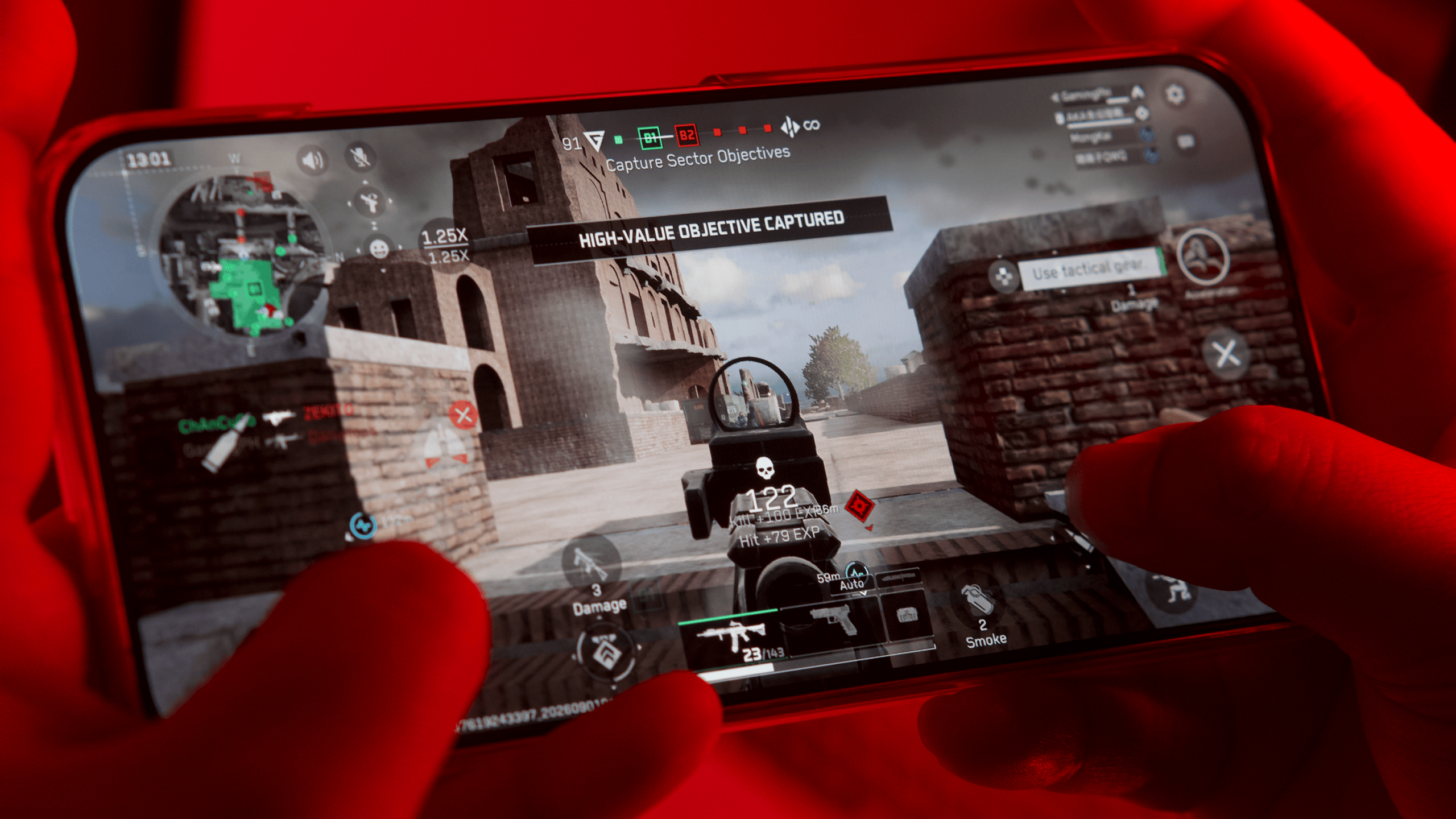
Instead, we tested eight demanding and competitive games to evaluate perceived smoothness, responsiveness, temperature, audio positioning, and noticeable frame drops during actual gameplay.
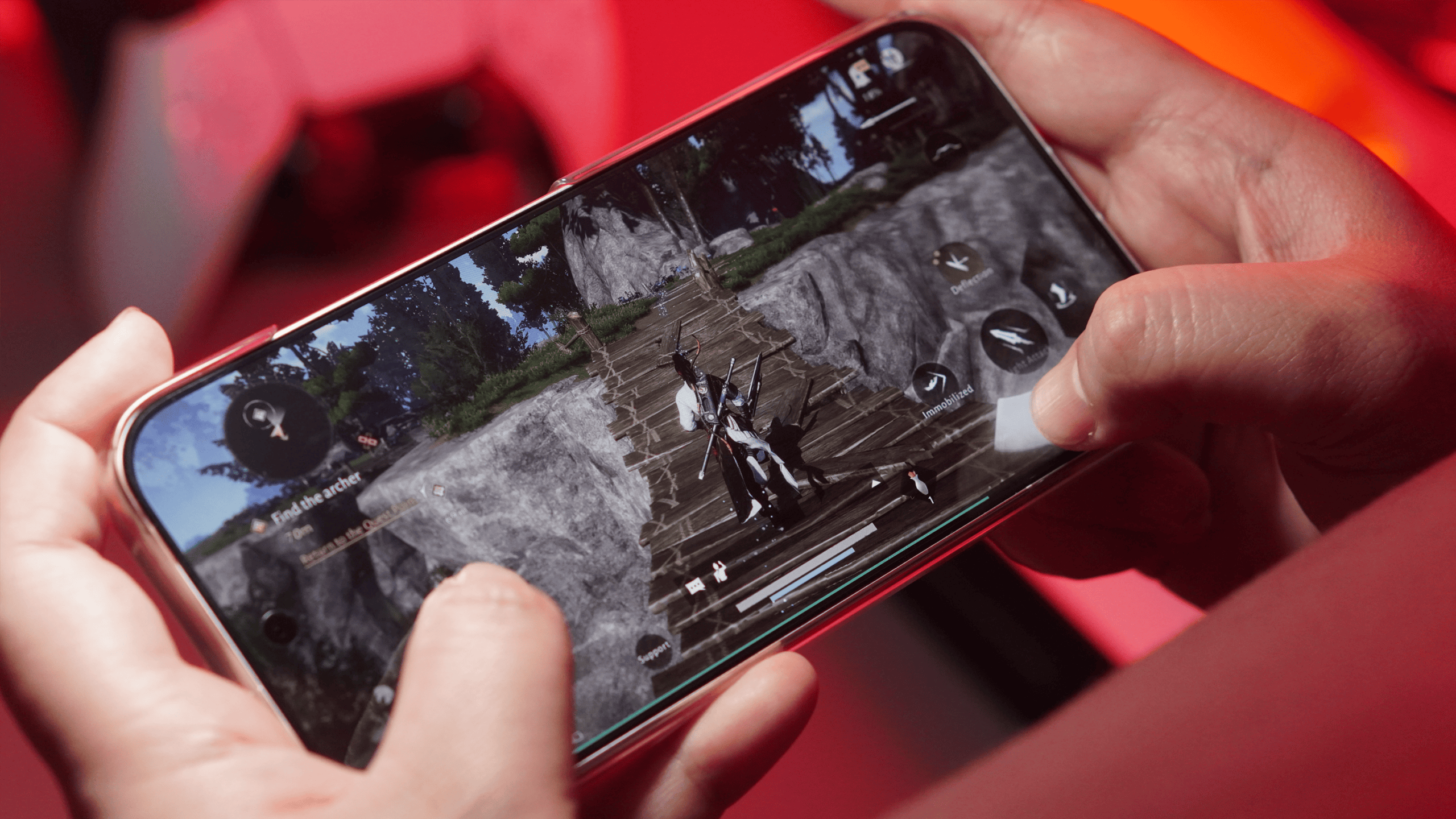
| Game | Gameplay experience | Temperature and notable features |
|---|---|---|
| Where Winds Meet | Cinematic sequences played smoothly, while exploration and combat remained responsive and highly playable. We did not notice major frame drops during battles, including scenes with flashy attacks and numerous visual effects. | The phone became warm, but the temperature remained manageable throughout our session. |
| Garena Delta Force | Large battles involving numerous soldiers, explosions, and environmental effects remained smooth and playable without noticeable frame drops. | Sound by Bose made footsteps and gunfire easier to locate. Gyroscope controls were responsive and helpful when aiming, while the phone’s heat remained manageable. |
| PUBG Mobile | Gameplay felt consistently smooth and responsive during movement, aiming, and firefights, with no disruptive frame-rate drops observed during our test. | Directional audio made nearby footsteps and the direction of gunfire easier to identify, improving situational awareness. |
| Wuthering Waves | Both cinematic sequences and combat played smoothly. Even during visually demanding encounters, we did not encounter noticeable frame drops that affected playability. | The phone became warm under load, but its temperature remained manageable. |
| Genshin Impact | Exploration, cutscenes, and combat delivered a similarly smooth experience to Wuthering Waves. Character switching and effect-heavy battles remained responsive and playable. | Heat gradually became noticeable during gameplay but stayed within a manageable level. |
| The Division Resurgence | Gunfights remained smooth even with several enemies, environmental details, and multiple combat effects appearing simultaneously. We did not notice disruptive frame drops during our session. | The phone became warm during extended action but remained comfortable enough to continue playing. |
| Crystal of Atlan | Cinematic sequences, movement, and effect-heavy combat felt smooth and highly playable, without noticeable frame drops interrupting the experience. | Thermal output remained manageable throughout the test. |
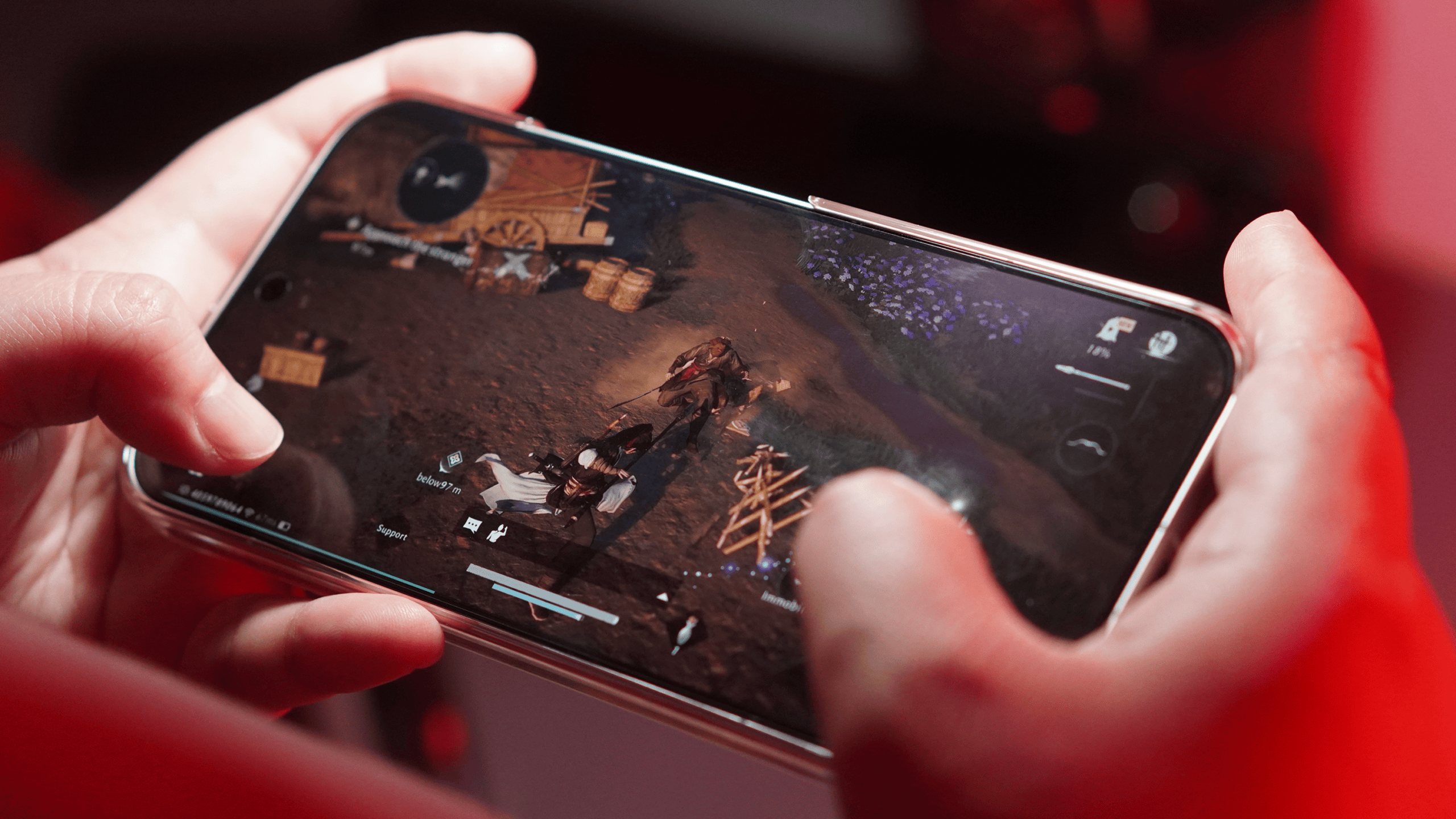
| Mobile Legends: Bang Bang | This provided the smoothest experience among the games we tested. Controls felt immediate, touch response was excellent, and perceived input latency was low during movement, skill activation, and team fights. | Heat was barely noticeable, even during longer gaming sessions. |
Among the games we tested, Mobile Legends: Bang Bang best demonstrated the phone’s responsive display and touch controls, while Garena Delta Force and PUBG Mobile benefited most from its directional audio and gyroscope response. More demanding titles such as Where Winds Meet, Wuthering Waves, Genshin Impact, The Division Resurgence, and Crystal of Atlan also remained smooth and playable despite their complex environments and effect-heavy battles.

Overall, the POCO F9 Pro delivered an excellent real-world gaming experience across every title in our test. We observed no persistent stuttering or frame-rate drops severe enough to affect gameplay, while thermal output remained manageable even in graphically demanding games. Although these observations are based on perceived performance rather than independently measured FPS, they confirm that the phone has enough sustained power for both competitive and visually demanding mobile games.
Charging
The POCO F9 Pro is equipped with a large 6,330mAh battery and supports up to 100W wired and 50W wireless HyperCharge. It can also supply power to compatible devices through up to 27W wired and 22.5W wireless reverse charging. Although our review package did not include a charging adapter, retail units purchased by consumers in the Philippines come with a compatible charger in the box.
We tested the phone using both 15W and 45W chargers. With the 15W charger, the battery went from 9% to 100% in 2 hours and 2 minutes. It recorded an average charging power of 10.7W, peaked at 12.2W, and reached a maximum temperature of 40.2°C.
Using the 45W charger reduced the charging time considerably, taking 1 hour and 25 minutes to go from 10% to 100%. However, the phone reached a peak charging power of only 27.8W, with an average of 15W throughout the test. Its maximum temperature was slightly lower at 38.7°C.
| Charger | Battery level | Charging time |
|---|---|---|
| 15W Intelligent Charging | 9%–100% | 2h 02m |
| 45W Intelligent Charging | 10%–100% | 1h 18m |
Overall, the 45W charger completed the charge around 44 minutes faster, although the phone did not draw its full advertised output. Actual charging speeds may depend on the charger, cable, and supported charging protocol.
Camera
The POCO F9 Pro is equipped with a 200MP main camera with optical image stabilization, a 50MP 2.5x floating telephoto camera with OIS, an 8MP ultra-wide camera, and a 32MP front-facing camera. This gives the phone a versatile camera system covering regular photos, portraits, distant subjects, wider scenes, selfies, and video recording.
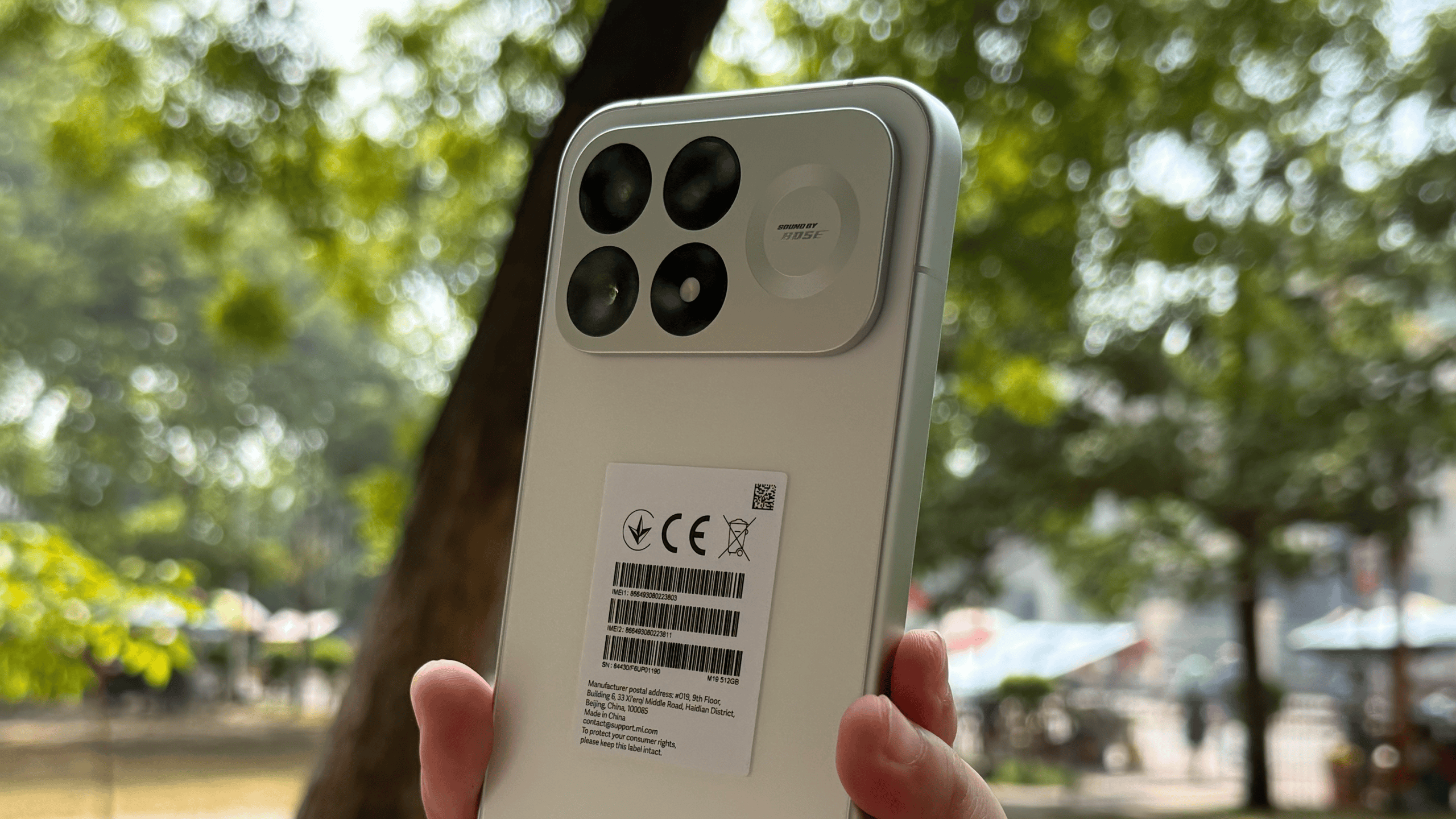
| Camera | Specification |
|---|---|
| Main camera (Upper Left Camera) | 200MP main camera with OIS, 1x shooting, with up to 2x lossless/in-sensor zoom |
| Telephoto camera (Upper Right Camera) | 50MP floating telephoto with OIS 2.5x optical zoom, up to 5x |
| Ultra-wide camera (Lower Left Camera) | 8MP 0.6x optical zoom |
| Front camera | 32MP |
| Video feature | 4K Live Cinematography |
Photo Quality
Based on our testing, the POCO F9 Pro captures clear and detailed photos with pleasing overall image quality. The main camera performs particularly well in properly lit environments, preserving plenty of detail while producing colors that look vibrant without making the image appear excessively processed.


Low-light performance was also better than we expected. Photos remained clear and usable even in dim environments, with the main camera retaining a good amount of detail. OIS helps the camera compensate for small hand movements, although users will still get the best results by holding the phone steady while the image is being captured.


The dedicated 200MP mode captures significantly more detail, offering greater flexibility when cropping or reframing photos. Images can reach an impressive resolution of up to 12288 × 16384 pixels.


Below is a small cropped portion of the full-resolution image, showing the level of detail captured by the 200MP mode.

Telephoto and Ultra-Wide Cameras
The 50MP floating telephoto camera provides a useful 2.5x optical zoom for portraits, street photography, and subjects that cannot be approached closely. Its focal length allows tighter framing without depending entirely on a digital crop from the main camera. The included OIS also helps maintain clearer results when shooting at a distance.


Here’s how it looks in low-light condition, but still preserves color and its quality.


The 8MP ultra-wide camera provides a broader field of view for landscapes, architecture, large groups, and confined spaces.


However, because of its lower resolution, users should expect less fine detail compared with the 200MP main camera and 50MP telephoto camera, particularly in low-light environments.


Front Camera
The 32MP front camera captures detailed selfies and is also suitable for video calls and social-media content. Results are clearest with proper front-facing illumination, while softer or uneven lighting may reduce fine facial detail.


Video Recording
The POCO F9 Pro supports 4K Live Cinematography with focal transitions and several creative recording effects. Its Ultra-HD option prioritizes detail, Freestyle provides automated zoom transitions for travel-style footage, and Portrait effects can produce quick zoom-out movements that add depth and emphasis to the subject. Video quality is generally clear and detailed, making the phone suitable for recording everyday moments and social-media content.


Our main concern is stabilization, as handheld footage can show noticeable movement while walking, changing direction, or shifting between focal lengths. The phone produces smoother results when held with both hands or moved slowly and deliberately, while a tripod or gimbal may be helpful for more demanding shots. Overall, video quality is impressive, but stabilization is not as consistent or polished as the phone’s excellent still-photo performance.
Conclusion
The POCO F9 Pro delivers on the performance focus of its title. Its Snapdragon 8 Elite Gen 5 V-series platform, Adreno 840 GPU, LPDDR5X memory, and UFS 4.1 storage produced excellent results across every benchmark we tested. Sling Shot and Wild Life even returned “Maxed Out” results because the phone was too powerful for those workloads, while the more demanding Solar Bay and Steel Nomad tests demonstrated its capability with modern graphics and ray tracing.
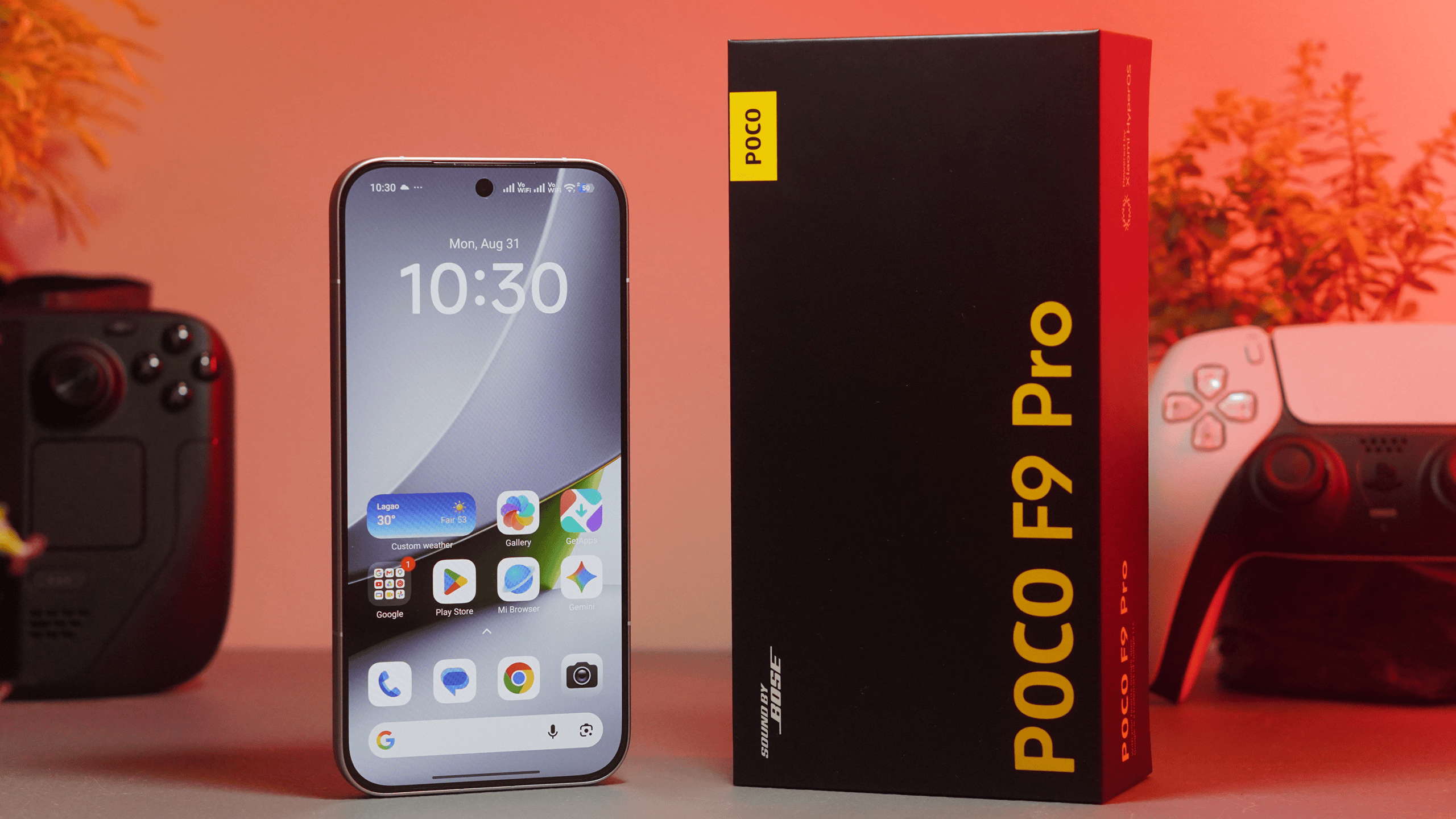
Its 185Hz AMOLED display complements that power with smooth motion and highly responsive touch controls, particularly in competitive games such as Mobile Legends: Bang Bang. Demanding titles including Where Winds Meet, Wuthering Waves, Genshin Impact, and The Division Resurgence also remained smooth and playable without disruptive frame drops during our sessions. Sustained stress tests produced some expected throttling and higher temperatures, but heat remained manageable during actual gameplay.
Beyond gaming, the phone offers a clean flagship-inspired design, useful Bose-tuned directional audio, and a versatile camera system capable of producing clear photos even in low light. Video stabilization could be more consistent, the charging adapter is not included, and the maximum 185FPS experience is limited to selected supported titles. Even with those considerations, the POCO F9 Pro is an excellent choice for users who want maxed-out benchmark performance, a 185Hz display, and smooth real-world gaming without the aggressive appearance of a traditional gaming phone.
Our 12GB + 512GB review unit carries an RRP of ₱54,999, placing it firmly within flagship territory. Its ₱49,999 early-bird price, which also includes a free Redmi Buds 8 Active, makes the package considerably more competitive. At its regular price, the POCO F9 Pro is best suited to users who prioritize raw performance and a high-refresh-rate display. Under the early-bird promotion, however, it becomes a much stronger value for gamers seeking flagship-level performance without the aggressive styling of a traditional gaming phone.
- POCO F9 Pro: http://shopee.ph/universal-link/product/178878361/29345548081/
- POCO F9 Ultra: http://shopee.ph/universal-link/product/178878361/41983663000/
#POCOF9Series #POCOF9Pro #POCOF9Ultra