The TeamGroup T-Force GA Pro SSD is a PCIe Gen5 x4 NVMe drive aimed at users looking to access next-generation storage speeds at a relatively lower price point. Rated for sequential read speeds of up to 10,000MB/s and write speeds up to 8,500MB/s, it utilizes the InnoGrit IG5666 controller, includes a DRAM cache, and features 4K LDPC error correction to support performance and data integrity. The drive is equipped with a graphene-based heat spreader, which provides passive thermal management without the need for a built-in heatsink.

In the US, the T-Force GA Pro is priced at around $89 for the 1TB variant (PHP 5,012 in Philippine currency), positioning it among the more affordable PCIe Gen5 SSDs currently available. This makes it an appealing option for gamers, content creators, and PC users seeking higher transfer speeds without stepping into premium territory.
As with many Gen5 SSDs, thermal performance during sustained workloads remains a point of consideration. The drive features a graphene-based heat spreader, but whether that’s sufficient for consistent high-speed operation depends on real-world usage. To evaluate this, we put the T-Force GA Pro 1TB through a range of benchmarks and practical tests to assess how well it delivers on its performance claims and overall value.
Packaging
The front of the packaging showcases a clean and modern design typical of TeamGroup’s T-Force branding. With its use of bold red accents and angular graphics, the layout highlights key product features such as PCIe Gen5 support, NVMe 2.0 compatibility, and the 1TB capacity. A product image of the SSD is also featured, along with its rated 10,000MB/s sequential read speed.

The back of the box offers additional technical information and product specifications. It includes multilingual descriptions that highlight the SSD’s support for NVMe 2.0, its high-speed performance capabilities, and a 5-year limited warranty.

The T-Force GA Pro SSD
The front view of the T-Force GA Pro 1TB reveals a minimalist and functional design. A matte black graphene heat spreader covers most of the PCB, with the T-FORCE and GA PRO logos printed in metallic gold for visual contrast.

From the side profile, the T-Force GA Pro maintains a slim and standard M.2 2280 form factor, making it compatible with most motherboards, including those with integrated heat shields or compact clearances. The graphene layer used for passive cooling is notably thin, and there’s no pre-installed heatsink.

On the back of the SSD, a standard product label displays essential technical information. This includes the TeamGroup logo, serial and model numbers, PCIe and NVMe certification icons, and a clear indication of the 1TB capacity along with a 5-year warranty notice. Although this side is typically hidden once the drive is installed, the labeling is clean and well-organized, same design peg with other Teamgroup’s SSD.

The Hardware
Under the graphene heatspreader, the T-Force GA Pro 1TB exposes a neatly arranged PCB layout, featuring a combination of performance-oriented components and cost-conscious design choices aimed at delivering Gen5-level speeds without excessive manufacturing overhead.

At the core of the T-Force GA Pro is the InnoGrit IG5666FAA controller, a PCIe 5.0 x4 NVMe solution built on InnoGrit’s Tacoma architecture. Fabricated using a 16nm process, this controller supports NVMe 2.0, offers low power operation, and is rated for theoretical speeds of up to 14 GB/s read and 11 GB/s write under ideal conditions. It also accommodates up to 16TB of NAND flash and supports high-speed NAND interfaces up to 2400 MT/s. While the GA Pro does not fully utilize the controller’s maximum capabilities, the IG5666FAA offers a solid platform for reliable Gen5-level performance and long-term scalability.

Paired with the controller is a SK Hynix H5AN8G6NOJ DDR4 SDRAM chip, functioning as the drive’s dedicated DRAM cache. This 8Gb (1GB) module runs at 1.2V and supports a data rate of 3200 MT/s, assisting in faster FTL (Flash Translation Layer) mapping and helping to sustain performance during write-heavy or multitasking scenarios. The inclusion of a discrete DRAM cache enhances overall responsiveness and consistency, offering a notable advantage over DRAM-less Gen5 SSDs in terms of stability under load.

For NAND storage, the GA Pro is equipped with TeamGroup’s proprietary FQBH02T 3D TLC NAND flash. While detailed specifications are not publicly available, chip markings and configuration suggest a 512GB per package design, with the 1TB variant utilizing two modules. This NAND is paired with 4K LDPC (Low-Density Parity-Check) error correction. According to TeamGroup’s specifications, the 1TB model is rated for 600TBW (terabytes written), aligning with typical endurance figures in this class.

Benchmark
To evaluate the real-world performance of the T-Force GA Pro 1TB, we ran a series of synthetic and real-world benchmarks under a typical mid-range gaming and productivity setup:
Test System Specifications:
- CPU: AMD Ryzen 9 7900
- Motherboard: Gigabyte X670 Gaming X AX (PCIe 5.0 capable)
- GPU: NVIDIA GeForce RTX 4060
- RAM: 16GB ADATA XPG Lancer RGB DDR5-6000MT/s
- OS Drive: Teamgroup T-Force GA Pro 1TB (Windows 11 Pro)
- Cooling: Graphene Heatsink and T-Force Dark Airflow 1 SSD Cooler
Before starting any performance tests, we checked the drive’s status via CrystalDiskInfo, which confirmed the SSD was in healthy condition (100%). When relying solely on the included graphene heatspreader, idle temperatures quickly climbed to 67°C and shoots up to 79°C after running benchmark, a common trait among Gen5 SSDs. These drives tend to generate significant heat, particularly in cases without dedicated airflow or active cooling.

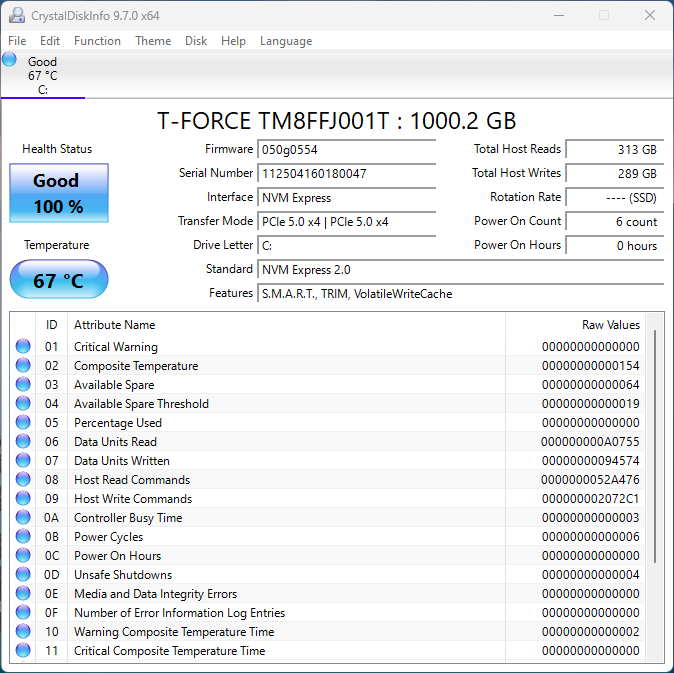
Some users have reported thermal-related performance drops in similar setups, and we were able to replicate those conditions during our early tests. However, after reinstalling the motherboard’s integrated M.2 heatsink on top of the graphene layer and ensuring proper case ventilation, the drive operated within more acceptable thermal ranges under load. It’s important to note that the graphene layer functions primarily as a heat transfer surface, it helps spread the heat but requires external heatsinks and adequate airflow to effectively dissipate it.
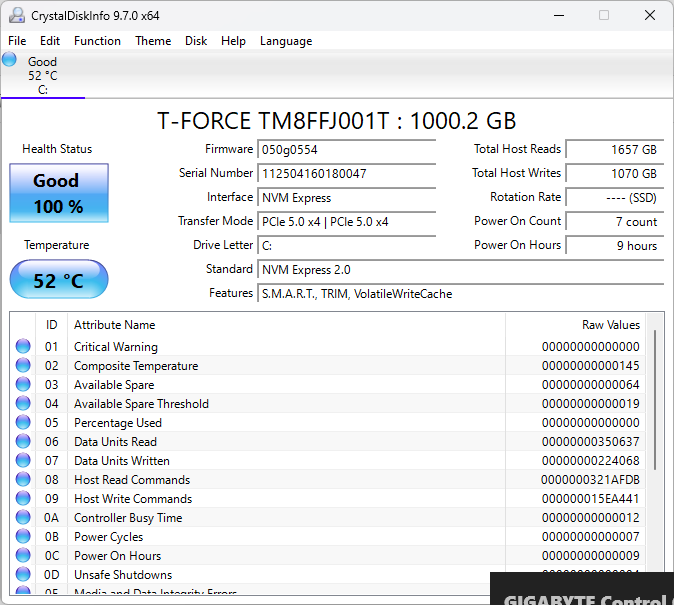
With the cooling properly configured, we proceeded to run a full suite of benchmarks to evaluate how well the GA Pro performs under both typical and intensive workloads. Here’s now the SSD temperature:

CrystalDiskMark Benchmark
In CrystalDiskMark 9.0.1, the T-Force GA Pro 1TB delivered impressive Gen5-level performance that closely aligns with its advertised specifications.

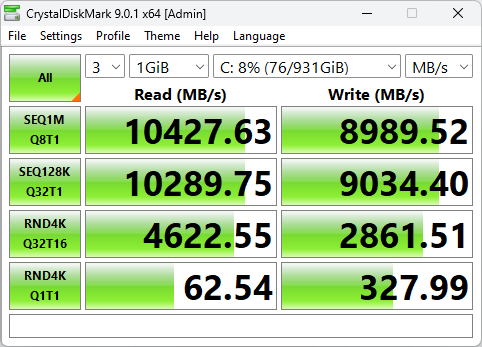
Sequential read speeds peaked at 10,472 MB/s, while write speeds reached 8,989 MB/s, showcasing the drive’s ability to handle high-bandwidth tasks like game loading, large file transfers, and content creation workflows with ease. Random performance was equally solid, with 4K Q32T16 read speeds at 4,622 MB/s and write speeds hitting 2,861 MB/s—excellent results for multitasking and small file operations. Even single-threaded 4K performance came in respectably at 62.54 MB/s read and 327.99 MB/s write.
AS SSD Benchmark
In the AS SSD Benchmark, the T-Force GA Pro 1TB continued to demonstrate solid real-world performance across the board.

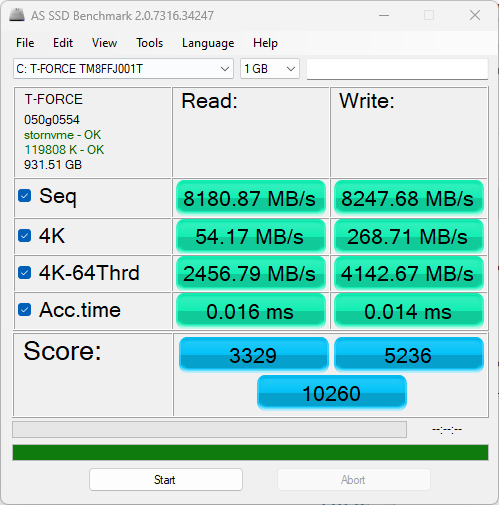
In AS SSD, the T-Force GA Pro 1TB achieved 8,180 MB/s read and 8,247 MB/s write in sequential tests, slightly lower than CrystalDiskMark but still strong for a Gen5 drive. 4K random performance reached 54.17 MB/s read and 268.71 MB/s write, with high-threaded 4K-64 tests scaling up to 2,456 MB/s read and 4,142 MB/s write. Access times remained low at 0.016 ms read and 0.014 ms write, and the drive earned an overall score of 10,260. While more conservative, these results reflect the drive’s solid sustained performance under realistic conditions.
HD Tune Pro Benchmark
We also tested the T-Force GA Pro 1TB using HD Tune Pro 5.75 to observe performance over a long continuous read workload across the entire 1TB capacity. The drive delivered an average transfer rate of 2,721.6 MB/s, with peaks reaching 2,890.2 MB/s and a minimum dip to 917.0 MB/s. Despite some initial fluctuation, the performance quickly stabilized and remained consistent throughout the rest of the test. Access time was measured at 0.025 ms, and burst rate hit 1,569.4 MB/s, with minimal CPU usage at just 1.3%.

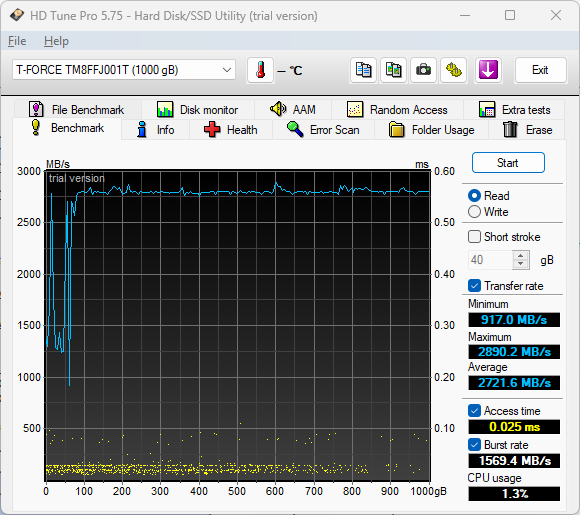
This test confirms that while the drive is capable of sustained throughput, and based from the graph, there are no drops in speed.
3DMark Storage Benchmark
In the 3DMark Storage Benchmark, the T-Force GA Pro 1TB scored 3,214 points, significantly above the average of 2,261. This test simulates common gaming storage tasks like game loading, installation, and saving.

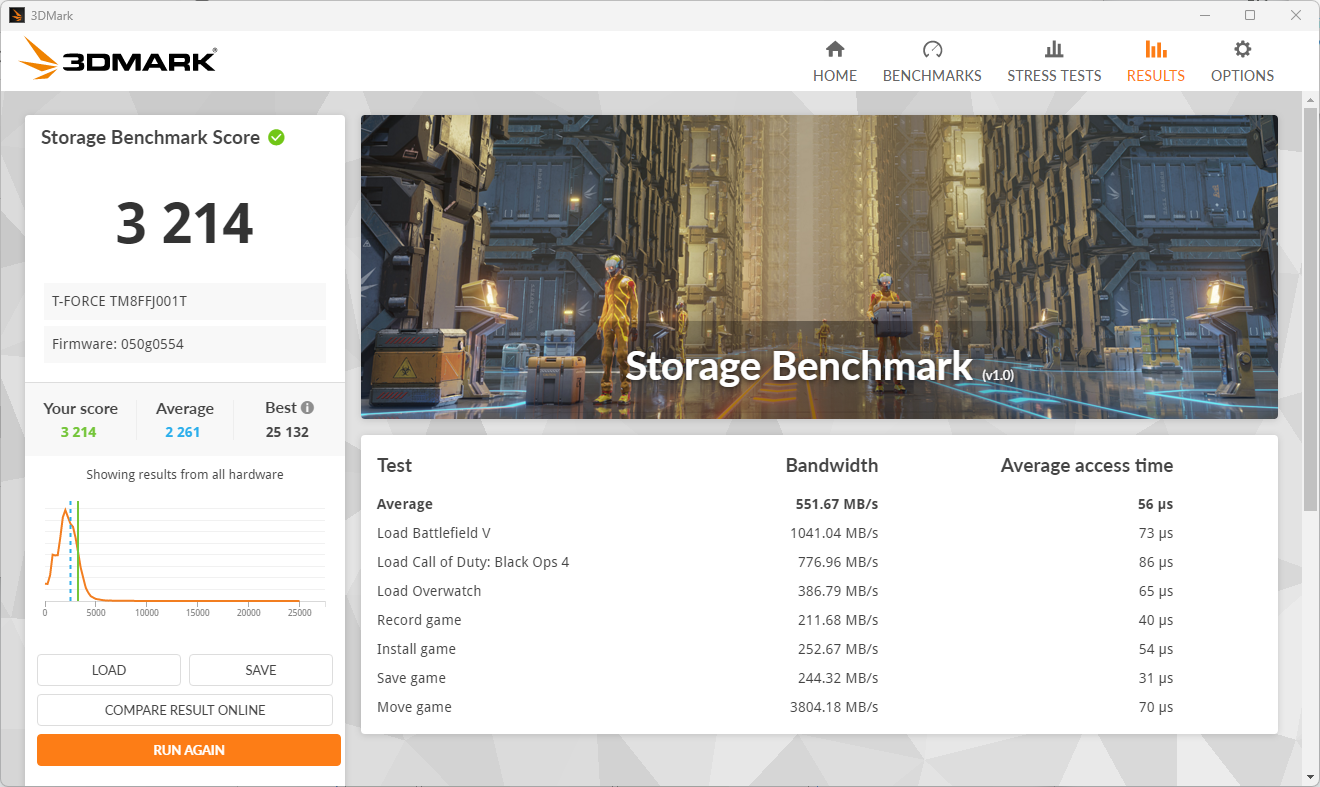
The drive achieved an average bandwidth of 551.67 MB/s and an average access time of 56 microseconds. Specific results include:
- Load Battlefield V: 1041.04 MB/s
- Load Call of Duty: Black Ops 4: 776.96 MB/s
- Load Overwatch: 386.79 MB/s
- Move game: 3804.18 MB/s
- Install game: 252.67 MB/s
- Save game: 244.32 MB/s
Real-World File Transfer Speed
To test real-world performance, we performed a large file transfer using the Windows file explorer. During the copy process, the T-Force GA Pro 1TB achieved a sustained transfer speed of 2.32 GB/s while copying a 20GB file.

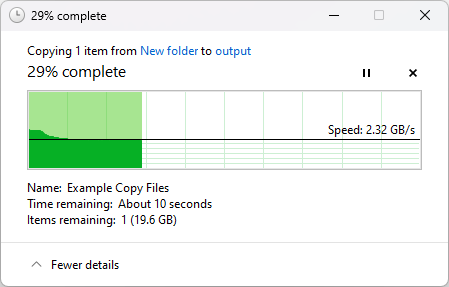
While this is significantly lower than synthetic benchmark results, it’s typical for real-use scenarios where factors like caching, thermal conditions, and file type come into play. Still, it’s a strong result that reflects reliable day-to-day performance when handling large files.
PCMark 10 Full System Drive Benchmark
In the PCMark 10 Full System Drive Benchmark, the T-Force GA Pro 1TB scored 2,716 points, reflecting solid real-world system performance for everyday computing tasks. The test measured an overall bandwidth of 429.3 MB/s and an average access time of 61 microseconds, both of which are competitive for a Gen5 SSD in a consumer-grade setup.

This benchmark simulates full-system drive usage, including app launches, file operations, and background tasks—providing a realistic view of how the SSD performs in daily use scenarios beyond just peak transfer speeds.
Mac Mini M4 Benchmark (External SSD)
We also tested the T-Force GA Pro 1TB using a PCIe Gen4 external SSD adapter connected to the new Mac Mini M4, to see how it performs as a portable high-speed storage solution on macOS.
AmorphousDiskMark
In the benchmark, the GA Pro reached up to 1,866 MB/s read and 1,858 MB/s write, which is a solid result considering the bandwidth limitations of most external enclosures. Performance stayed consistently above 1,600 MB/s across multiple tests, with lower speeds appearing in random or smaller file operations—as expected from any SSD used over USB or Thunderbolt interfaces.

For comparison, the built-in Macintosh HD on the Mac Mini M4 delivered significantly faster results, scoring 3,513.78 MB/s read and 3,589.65 MB/s write, thanks to Apple’s tightly integrated storage architecture and full PCIe Gen4 x4 bandwidth internally. While the GA Pro can’t match the internal SSD’s performance on Mac, it still provides a strong external storage option for large file transfers, backups, or expanding storage without using the system as main storage.
BlackMagic Disk Speed Test
In the Blackmagic Disk Speed Test, the T-Force GA Pro 1TB, connected via a PCIe Gen4 external SSD adapter, reached write speeds of 1,774.5 MB/s and read speeds of 1,712.0 MB/s when used with the Mac Mini M4. While this is solid performance for an external SSD—sufficient for 4K and some 8K workflows

For comparison, it still falls short compared to the built-in Macintosh HD, which delivered 3,423.9 MB/s write and 2,991.8 MB/s read. The significant speed advantage of the internal SSD is expected, as it leverages Apple’s high-speed storage controller and tightly integrated architecture. Nonetheless, the GA Pro remains a competent and practical external option for creators needing fast and reliable storage on the go.
Conclusion
The T-Force GA Pro 1TB delivers solid PCIe Gen5 performance at a price point that’s hard to ignore. Priced around $89, it offers sequential speeds that match its advertised specs, topping 10,000 MB/s read and 8,900 MB/s write in CrystalDiskMark, and scoring over 10,000 points in AS SSD. Even under extended workloads, such as our full-capacity HD Tune Pro test, the drive maintained consistent performance with only minor fluctuations, confirming its ability to handle sustained operations reliably.

Thermally, the drive does run warm. We recorded idle or light-use temperatures around 67°C when using only the included graphene heat spreader. While this didn’t result in thermal throttling during our tests, it’s clear that active airflow or pairing the graphene with the motherboard’s heatsink is recommended for optimal performance in prolonged use. Once properly cooled, the GA Pro showed no signs of instability or performance loss.
For users building a next-gen system or upgrading to Gen5 without overspending, the T-Force GA Pro strikes a compelling balance between value, performance, and reliability. Just be sure your system has the cooling to match its speed.
Pros
- Excellent Sequential Performance: Reaches up to 10,472 MB/s read and 8,900 MB/s write speeds (CrystalDiskMark).
- Affordable Gen5 Option: Competitive pricing at around $89 for 1TB.
- DRAM Cache Included: Improves responsiveness and sustained write performance over DRAM-less models.
- Stable Under Load: Performs consistently even during long, full-capacity operations.
- NVMe 2.0 & Gen5 Ready: Offers future-proof compatibility with modern platforms.
Cons
- Runs Hot: Idle temps reached 67°C with only the graphene heatspreader.
- Requires Proper Cooling: Best paired with a motherboard heatsink and good case airflow to avoid thermal buildup.
- No Pre-installed Heatsink: Users must rely on existing motherboard solutions or purchase an aftermarket cooler.
- Performance Drops Without Adequate Ventilation: Some throttling risk under sustained heavy use if airflow is poor.